She Told His Daughter to Leave the Family Picture—His Response Left Her Speechless
They were standing together for what should have been a happy family photograph. Colorful birthday balloons filled the room, three children stood in front, and two adults were ready to pose. But one woman’s request turned the celebration into an unforgettable confrontation.
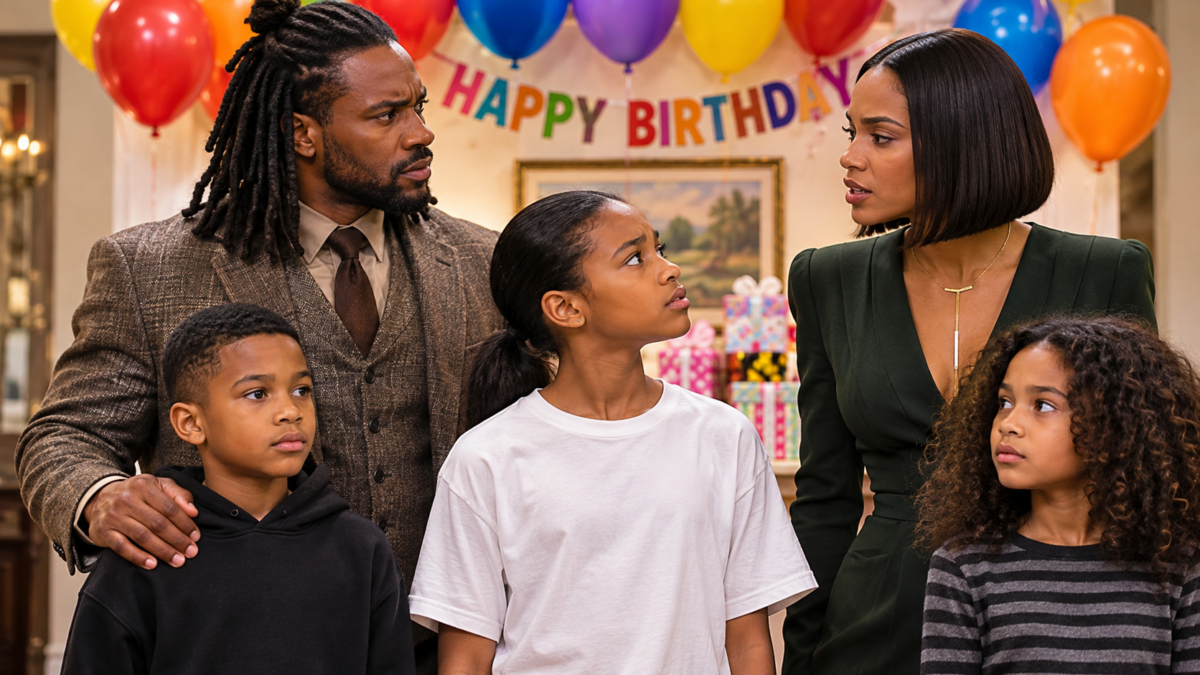
The birthday decorations were bright and cheerful.
Red, blue, yellow, orange and purple balloons hung against the cream-colored walls.
A colorful banner spelled out “HAPPY BIRTHDAY.”
Wrapped gifts rested on a table farther back in the room.
Five people stood together, facing an unseen photographer.
A father wearing a textured brown-gray tweed suit stood at the back of the group. His shoulder-length dreadlocks framed his face, and one hand rested on the shoulder of a young boy in a black hoodie.
Beside the father stood an elegantly dressed woman with a sleek black bob, a dark green outfit and a delicate gold necklace.
Three children stood in front.
A young boy in black was on one side.
A curly-haired girl wearing a striped top and pleated skirt stood on the other.
And between them was a girl dressed in a simple oversized white T-shirt.
Everything looked ready for a family picture.
Then the woman spoke.
“Can You Step Out of the Picture?”
The woman turned toward the father and the girl in white.
Her voice sounded conversational, as though she were making an ordinary request.
“Baby, can you step out of the picture for a second? I just want a picture of our family.”
The words created an immediate change in the atmosphere.
The girl in the white T-shirt looked up toward the woman.
The father turned his head.
Until that moment, all five had been standing together.
There was no visible reason for the girl to be excluded from the photograph.
She was already part of the group.
But the woman’s wording suggested that she was drawing a distinction between this particular girl and the family she wanted to capture in the picture.
What should have been a joyful birthday memory suddenly became a question of belonging.
The father did not ignore the remark.
And he did not ask his daughter to move.
Instead, he challenged the woman’s request.
“She’s Family. She’s My Daughter.”
The camera moved closer to the father’s face.
His expression changed from confusion to disbelief.
He looked toward the woman and asked:
“What do you mean? She’s family. She’s my daughter.”
His response was immediate.
He did not treat the girl’s presence as something that needed to be negotiated.
He did not suggest taking one photograph with her and another without her.
He simply stated the relationship that mattered.
She was his daughter.
And to him, that was enough.
His words highlighted the difference between the way the two adults appeared to understand the family picture.
The woman had asked for the girl to step aside.
The father insisted that the girl belonged exactly where she was.
The children remained silent.
Nobody moved out of the group.
The conversation continued with the woman still facing the father.
“I Mean Our Family.”
The camera cut to the woman.
Her dark, chin-length hair framed her face.
The gold necklace at her neckline caught the soft indoor light.
For a moment, she gave a small smile.
Then she spoke again.
“You know what I mean. I mean our family.”
It was the second time she had emphasized the same idea.
Our family.
Those two words carried the conflict.
She seemed to expect the father to understand her distinction without further explanation.
But his daughter was standing right there.
She was not a stranger who had accidentally stepped into the photograph.
She was someone the father had just explicitly identified as his child.
Whatever the woman intended, her repeated wording made it clear that she still wanted a photograph without the girl in white.
The father heard her.
And this time, his answer was even more decisive.
A Father’s Response Changes Everything
The camera returned to a close-up of the father.
His expression was serious.
He looked directly toward the woman.
Then he delivered the words that became the defining moment of the entire scene.
“My daughter is important to me.”
He continued:
“If you have a problem with her being in this picture, then you can leave the picture or leave the family.”
The statement left little room for misunderstanding.
He was not prepared to exclude his daughter to satisfy another adult.
And he was not willing to let the family photograph become a place where his child was treated as though she did not belong.
His words were firm.
He did not smile.
He did not turn the conversation into a joke.
The woman had presented a choice about who should be included in the picture.
The father answered by establishing his own boundary.
If she had a problem with his daughter appearing in the photograph, then she was the one who could step away.
It was a confrontation about far more than where someone should stand for a camera.
It was about what family meant to each of them.
The Girl in the White T-Shirt
The young girl at the center of the disagreement had said nothing.
She stood among the other children wearing a plain white shirt and dark trousers.
Her long black hair was tied into a low ponytail.
When the woman made her request, the girl looked up.
The video did not show her arguing.
It did not show her demanding an explanation or speaking back.
But her silence did not make the situation any less significant.
She was standing in what had been arranged as a family picture.
And an adult was asking for her to be left out.
For a child, a family photograph can represent more than a posed image.
It can become a reminder of who stood together during an important occasion.
In this scene, the girl’s inclusion became the subject of an argument she had not started.
Her father recognized that.
And after speaking, he made a decision that was visible to everyone in the room.
He Took His Daughter’s Hand
The final scene moved back to a wider view of the birthday celebration.
The father stood near his daughter in the white T-shirt.
The woman remained nearby, dressed in her dark green outfit.
The curly-haired girl was still beside her.
The colorful birthday decorations remained in the background.
Then the father turned toward his daughter.
He took her hand.
And together, they turned away from the family-photo position.
The girl followed his lead.
Her long ponytail was visible down the back of her white shirt as they began walking toward the deeper part of the room.
The father’s brown tweed suit remained recognizable as he turned his back to the camera.
Neither of them delivered another line.
They simply walked together.
It was a quiet action after a tense conversation.
But it carried the meaning of his earlier words.
He had defended his daughter’s place in the picture.
And now, rather than allowing her to stand alone, he left the photo pose with her.
The Woman’s Reaction
The woman did not follow them.
She remained in the birthday room.
Her head turned as she watched the father and daughter walk away.
Her lips parted slightly, and her expression showed surprise.
The curly-haired girl stayed nearby.
The video did not show the woman apologizing.
It did not show her running after them.
There was no reconciliation scene and no second attempt at a photograph.
The father and daughter were still inside the birthday room when the clip ended.
Their departure was from the group pose, not a confirmed departure from the home or the family itself.
That distinction matters because the short film ends before any later consequences are revealed.
What we actually see is the father’s immediate response to the request—and the choice he makes in front of his daughter.
Why This Family Picture Became So Important
At first, the situation might appear to be a small disagreement about a photograph.
But the tension comes from what the picture represents.
The woman wanted a version of the group that did not include the girl in white.
The father believed that his daughter was an essential part of his family.
Those two views could not be reconciled simply by asking the girl to move.
The father did not need to know what the final photograph might look like.
He had already decided what mattered more.
His daughter’s place beside him was not something he was willing to sacrifice.
The moment also shows how much meaning can be carried by a small gesture.
A parent placing a hand on a child’s shoulder.
A child looking up when an adult speaks.
A father turning away from a photograph.
And finally, a father taking his daughter’s hand.
None of those gestures requires an elaborate explanation.
They are visible actions that give emotional weight to the conversation.
The Real Meaning of “Family”
The most striking part of the scene is the contrast between two statements.
The woman says:
“I mean our family.”
The father says:
“She’s family. She’s my daughter.”
Both use the word family.
But they use it in very different ways.
For the woman, the requested photograph would exclude one of the children standing in front.
For the father, that exclusion would undermine the very purpose of the picture.
He did not believe that his daughter’s place in the family should depend on whether someone else wanted her in the frame.
His answer was direct.
And his final action made his position unmistakable.
If the photograph could not include his daughter, he would not remain in the pose without her.
An Ending Without an Apology
The story ends with the father and daughter walking away together.
There is no new photograph.
No apology.
No explanation from the woman after his final statement.
We do not know what happens between the adults afterward.
We do not know whether they resolve their disagreement.
And the video does not confirm the wider family relationships of the other two children.
What it does show is one father’s response to seeing his daughter excluded.
He spoke for her when she was silent.
He refused the distinction the woman was making.
And when the conversation ended, he reached for his daughter’s hand.
The birthday picture was supposed to capture a happy family moment.
Instead, it revealed how differently two adults understood who belonged.
And the father made his answer clear:
His daughter was not someone he was willing to leave outside the frame.
Editor’s note: This article is a fictionalized narrative adaptation of a short dramatic family video. The birthday setting, characters, dialogue and final walking-away scene are depicted in the source. The relationship status of the adults and events after the video ends are not established.