**“GET OUT OF MY WAY!”**

The cruel words cut through the elegant ballroom.

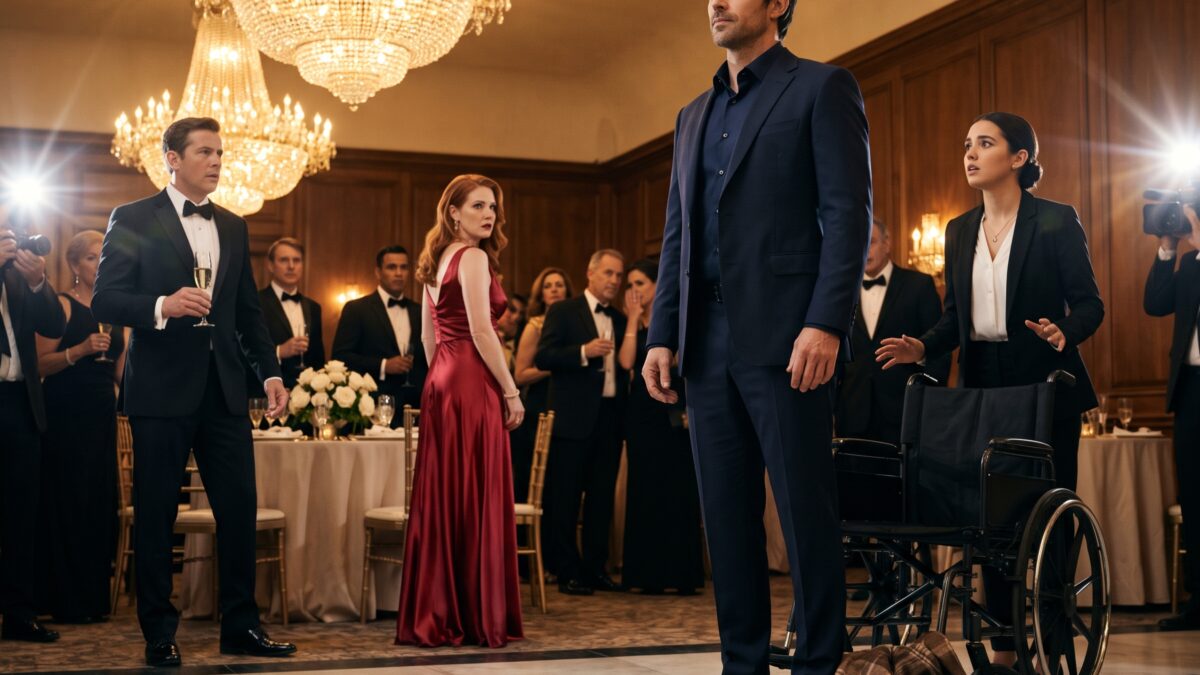
A red-haired woman in a stunning fuchsia satin gown stood beside a man seated in a black wheelchair.

Her name was Charlotte Whitmore, thirty-six, one of the most influential event directors in the city.

She had spent months organizing this exclusive charity gala.

And she was furious that someone was blocking her path.

The man, thirty-five-year-old Daniel Mercer, wore an expensive navy suit, a matching shirt and tie, and a silver wristwatch.

A brown checkered blanket covered his legs.

His blue-gray eyes lifted toward Charlotte.

He said nothing.

Charlotte rolled her eyes, adjusted her diamond earrings, and walked away.

Around them, wealthy guests continued drinking champagne beneath magnificent crystal chandeliers.

Nobody intervened.

But a young woman standing near the banquet tables had witnessed everything.

Her name was Maya Ellis.

She was twenty-six, with dark hair arranged in a neat low bun.

She wore a black blazer over a white shirt.

Unlike the other guests, Maya didn't seem interested in the expensive dresses or glittering jewelry.

She noticed Daniel sitting alone.

She approached him and bent slightly so they could speak at eye level.

**“ARE YOU OKAY?”**

Daniel studied her face.

There was no pity in her expression.

Only genuine concern.

He looked toward Charlotte, who was now laughing with a group of wealthy guests.

Then he turned back to Maya.

**“I NEED TO KNOW WHO IS KIND.”**

Maya blinked.

She didn't understand.

Before she could respond, Daniel shifted the blanket from his knees.

He placed his feet carefully on the marble floor.

Then he slowly rose from his wheelchair.

Maya instinctively stepped closer, ready to offer assistance if he wanted it.

But Daniel steadied himself.

And stood upright.

Across the room, Charlotte froze.

Her champagne glass trembled in her hand.

**“YOU CAN STAND?”**

Daniel looked at her calmly.

Then he turned toward Maya.

**“COME WITH ME.”**

He gestured toward the doors at the far end of the ballroom.

Maya hesitated.

She had no idea why this stranger wanted her to follow him.

But when Daniel opened his jacket, she noticed a small gold emblem on his lapel.

It was the same emblem displayed on the enormous banner above the stage.

**THE OPEN DOOR FOUNDATION.**

Maya's heart began to race.

Because the gala was being held to celebrate that very foundation.

And Charlotte had no idea that the man she had just humiliated was the person responsible for reviewing every dollar the event had raised.

**But the real scandal wasn't Charlotte's insult.**

**It was the document Daniel had discovered just hours before the party.**

---

### THE MAN BEHIND THE FOUNDATION

Daniel Mercer had not always used a wheelchair.

Five years earlier, a serious accident had changed his mobility.

After extensive treatment and rehabilitation, he regained the ability to stand and take a limited number of steps on some days.

But walking for long periods remained painful and exhausting.

He continued using a wheelchair whenever he needed it.

There was nothing unusual about that.

Many wheelchair users can stand or walk to varying degrees.

Daniel had learned to adapt his daily life to his own abilities.

But he had also learned how quickly strangers made assumptions.

Some treated him as though he couldn't make decisions for himself.

Others spoke to whoever accompanied him instead of addressing him directly.

And occasionally, when they saw him stand, they accused him of pretending to have a disability.

Daniel had grown tired of explaining that standing for a moment didn't erase his mobility limitations.

Instead, he began channeling his frustration into something constructive.

Two years after his accident, he established the Open Door Foundation.

Its mission was simple.

Make public events, cultural venues, and professional opportunities more accessible.

The foundation funded improvements to community spaces and supported training for workers with disabilities.

It also helped businesses evaluate whether their accessibility promises matched reality.

Daniel was its founder and board chair.

But he avoided publicity whenever possible.

He preferred to attend events quietly, listening to the people whose experiences were usually overlooked.

---

### THE WOMAN WHO CARED ONLY ABOUT APPEARANCES

Charlotte Whitmore had built her reputation organizing extravagant events.

She worked with luxury hotels, wealthy donors, and influential business owners.

Her parties were famous for their magnificent decorations.

Perfectly arranged flowers.

Imported tableware.

And carefully controlled guest lists.

When she won the contract to organize the Open Door Foundation gala, Charlotte saw an opportunity to expand her business.

But she didn't understand the foundation's mission.

To Charlotte, accessibility was another item on a planning checklist.

She wanted the venue to look beautiful.

And she believed visible mobility equipment would spoil the photographs.

During the preparations, several staff members raised concerns about the narrow spaces between banquet tables.

One entrance had a difficult threshold.

An accessible seating area had been used for decorative displays.

And the route to the main stage was partially obstructed.

Charlotte dismissed the complaints.

She insisted the ballroom was already elegant enough.

She promised that any problems could be handled on the night.

But one employee refused to accept that answer.

Maya Ellis.

---

### THE ASSISTANT EVERYONE IGNORED

Maya had worked at the luxury hotel for three years.

She began as a receptionist.

Through determination and long hours, she became an assistant guest-services coordinator.

She loved her job.

She enjoyed helping visitors feel welcome.

But she was frustrated by the way some senior managers treated guests according to wealth and appearance.

When the foundation event was announced, Maya was excited.

Her younger brother, Isaiah, used a wheelchair following a childhood illness.

She knew how exhausting it could be to arrive somewhere and discover that the entrance, seating, or restrooms were difficult to use.

For weeks, she tried to improve the gala arrangements.

She requested wider pathways between tables.

She asked for the accessible entrance to remain unobstructed.

She recommended that staff receive clear instructions on assisting guests without touching their mobility equipment without permission.

But Charlotte rejected several suggestions.

She accused Maya of complicating an otherwise simple event.

Then she warned her not to question decisions in front of important clients.

Maya feared losing her job.

But she continued documenting her concerns and forwarding them through the hotel's established reporting channels.

She never imagined anyone important would read them.

---

### THE DOCUMENT THAT CHANGED EVERYTHING

On the afternoon of the gala, Daniel received the final event report.

According to the document, the ballroom had passed every accessibility review.

All pathways were supposedly clear.

Accessible seating had been reserved.

Staff training was marked complete.

Daniel was pleased.

Until he received a second message.

It came from the foundation's independent accessibility consultant.

The consultant had visited the venue earlier that day.

His findings contradicted the official report.

Several problems had not been resolved.

More troubling, the report claimed that adjustments had been completed even though photographs showed otherwise.

Daniel called the hotel's operations director.

He asked to review the discrepancies.

But instead of immediately canceling the evening, he agreed to attend while the responsible teams verified the situation and corrected what they could.

He arrived without publicity.

Not to trick anyone into revealing prejudice.

Not to test whether strangers would help him.

He simply wanted to see how the event was operating.

And whether the foundation's guests were being welcomed with dignity.

That's when Charlotte ordered him out of her way.

---

### FIVE WORDS THAT REVEALED MORE THAN A THOUSAND PHOTOGRAPHS

When Charlotte dismissed Daniel, he felt the familiar sting of being treated as an inconvenience.

But Maya's question affected him differently.

**“Are you okay?”**

She hadn't demanded an explanation about his wheelchair.

She hadn't assumed he needed assistance.

She had simply checked whether he was all right.

For Daniel, that small gesture represented everything the foundation was trying to teach.

Kindness wasn't a publicity campaign.

It wasn't a slogan printed above a stage.

It was how people treated one another when there was no camera recording the moment.

When he told Maya he needed to know who was kind, he wasn't asking her to prove herself.

He was thinking aloud about the difference between the foundation's public promises and what he had just witnessed.

And when he stood, he wasn't demonstrating that his wheelchair was unnecessary.

He was preparing to transfer to a nearby seat where he could review the documents more comfortably.

But Charlotte saw only what she wanted to see.

A man she had assumed couldn't stand had just risen from his wheelchair.

Her shock revealed how little she understood.

---

### THE MEETING BEHIND THE BALLROOM DOORS

Daniel asked Maya to accompany him to a private meeting room.

He returned to his wheelchair before they crossed the ballroom, explaining that it was more comfortable for the distance.

Maya followed, still confused.

Inside, the hotel's operations director and two foundation representatives were waiting.

When Daniel entered, they greeted him respectfully.

Maya realized who he was.

**The founder of the Open Door Foundation.**

She stood speechless.

Daniel explained that he had reviewed the event's accessibility documentation.

He asked Maya whether she had been involved in the planning.

Her expression changed.

She hesitated before answering.

Then she admitted that she had raised concerns about the seating layout and blocked access routes.

She explained that some adjustments were still unfinished.

Daniel showed her the final report.

Maya stared at the document.

Her name appeared beside an acknowledgment indicating that she had approved the arrangements.

But she had never signed that approval.

**Someone had used her name to make the report appear complete.**

And she knew exactly who had insisted the event was ready.

---

### THE SECRET CHARLOTTE COULDN'T HIDE

The operations director requested an immediate review.

The hotel's electronic records showed that the approval had been entered through a senior event-management account.

Further checks linked it to Charlotte's team.

When confronted, Charlotte initially denied knowing anything about the discrepancy.

She insisted the arrangements were adequate.

But the photographs, inspection notes, and staff correspondence told a different story.

Maya's concerns had been repeatedly dismissed.

Several access problems had been marked as resolved without proper verification.

And the foundation had received an inaccurate final report.

Daniel listened carefully.

He refused to turn the matter into a public confrontation.

Instead, he instructed the organizers to correct the immediate barriers and ensure that guests had suitable access.

He also asked the foundation's board and hotel management to review the contractual and professional consequences.

Charlotte's event-management responsibilities were removed while the matter was investigated.

The gala continued only after the necessary practical adjustments were made.

But the atmosphere among the organizers had changed.

The woman who had been so concerned about maintaining a flawless appearance was now being questioned about the very promises she had made.

---

### THE SPEECH NOBODY EXPECTED

Later that evening, Daniel appeared before the guests.

He did not mention Charlotte by name.

He didn't ask anyone to feel sorry for him.

Instead, he spoke about what genuine inclusion required.

Accessible entrances.

Safe pathways.

Reliable information.

And the freedom for disabled people to participate without having to justify their presence.

He reminded the audience that a person using a wheelchair might be able to stand sometimes.

Another might not.

Neither situation determined that person's worth.

Then he acknowledged the employees and consultants who had raised concerns during the event's preparation.

Maya listened from the back of the ballroom.

For the first time, she felt that her work had been noticed.

After the speech, Daniel approached her.

He thanked her for taking the concerns seriously.

But he also acknowledged that employees shouldn't have to risk their jobs to ensure that accessibility requirements were respected.

He promised the foundation would work with its partner venues to improve reporting systems and accountability.

Maya smiled.

The most meaningful part wasn't being recognized by someone important.

It was knowing that future guests might encounter fewer barriers.

---

### SIX MONTHS LATER

Six months after the gala, the hotel reopened several renovated event spaces.

The entrances were easier to navigate.

The seating layouts allowed better access.

And staff had received practical training developed with disabled accessibility consultants.

Maya had become a senior guest-services coordinator through the hotel's normal promotion process.

Her responsibilities now included helping implement the improved accessibility procedures.

Charlotte no longer managed events for the hotel following the investigation into the inaccurate report.

Daniel continued his work with the foundation.

One afternoon, he returned to the ballroom for a smaller community event.

This time, the room looked different.

There were no unnecessary barriers between the tables.

Accessible seating was integrated throughout the space rather than isolated in a corner.

And guests moved freely through the hall.

Daniel entered in his wheelchair.

Maya greeted him at the door.

She didn't rush to push his chair.

She didn't assume he needed help.

She simply welcomed him.

Then she asked whether there was anything he needed.

Daniel smiled.

He looked around the room.

And for the first time in a long while, he felt that the foundation's principles had truly become part of the place.

---

### THE LESSON THE LUXURY GALA COULDN'T BUY

The night Charlotte ordered Daniel out of her way, she believed she was speaking to someone unimportant.

She judged him by the wheelchair beneath him.

She never imagined he was the founder of the organization hosting the gala.

But the greater mistake was believing that his identity mattered more than his dignity.

**Daniel didn't deserve respect because he was wealthy, influential, or capable of standing.**

**He deserved respect simply because he was a human being.**

And Maya's small question had demonstrated what Charlotte's expensive decorations never could.

A person's character is revealed through everyday choices.

Not by the price of a dress.

Not by the size of a donation.

And certainly not by how someone moves through the world.

**Because true elegance isn't found beneath crystal chandeliers.**

**It is found in the way we treat people when we believe they have nothing to offer us.