She Fed a Homeless Man With Her Last $7—Then His Son Walked Into the Diner Looking for Her
Emily Parker had almost nothing left. But when an elderly homeless man needed food, she made a choice that would bring a stranger back to the diner looking for her.
The money was only seven dollars.
To most people, it might not sound like much. But for Emily Parker, a young waitress working in a modest American diner, those seven dollars were the last money she had.
Still, when she saw an elderly homeless man who needed a meal, she couldn’t bring herself to turn away.
She offered him something warm to eat.
She expected nothing in return.
Then, sometime later, a well-dressed stranger walked into the same diner and asked a question that made Emily stop what she was doing.
“Which one of you is Emily Parker?”
She had no idea why he was looking for her.
And she certainly wasn’t prepared for what he was about to reveal.
A Cold Day at an Ordinary American Diner
The diner was the kind of place where people came for a hot meal, a cup of coffee and a brief escape from the cold.
Red leather stools lined the long metal counter. Black-and-white tiles covered the floor. Bright ceiling lights illuminated the tables, while a red neon sign glowed above the counter.
Outside the windows, the winter sky was gray.
Snow covered the streets beyond the glass doors.
Inside, Emily worked in her familiar uniform: a muted green waitress dress, a cream-colored cardigan and a white apron.
Her brown hair was gathered loosely at the back of her head, with a few strands falling around her face.
She looked like an ordinary young woman trying to get through an ordinary workday.
But a seemingly small act of kindness had already connected her life to someone she barely knew.
Someone named Walter Bennett.
The Elderly Man Who Had Nothing
Walter was an elderly man with a deeply lined face, a long gray beard and tired eyes.
He wore an old knitted cap and a faded dark coat that had clearly seen better days.
His appearance suggested he had spent a long time facing hardship.
At the diner counter, with a bowl of warm soup in front of him, he noticed Emily handling the money in her brown wallet.
He understood what she was offering.
And rather than immediately accepting it, he said something unexpected.
“You need that money more than I do.”
Those words revealed something important about their encounter.
Walter wasn’t simply asking for help without considering the cost.
He could see that Emily herself was struggling.
He knew the money mattered to her.
And he seemed reluctant to accept something she could barely afford to give.
But Emily had already decided what she wanted to do.
Seven Dollars and a Bowl of Soup
Emily looked at the elderly man with a gentle smile.
Instead of stepping away, she helped him with a hot bowl of soup.
Steam rose from the white ceramic bowl as she moved it toward him.
It was a simple meal.
There was no elaborate celebration, no grand speech and no crowd gathering around to congratulate her.
Just a young waitress and an elderly stranger sharing a brief moment of human kindness.
When Walter suggested that she needed the money more than he did, Emily answered with a line that carried both humor and compassion.
“Then stay alive long enough to repay me.”
She wasn’t demanding a payment.
Her words sounded more like a quiet encouragement to keep going.
For someone who appeared to have very little, hearing another person speak with that kind of warmth could mean more than the cost of the meal.
Walter lowered his eyes toward the soup.
He lifted a spoon and began eating.
The camera lingered on his weathered face, his gray beard and the warm food in front of him.
There was nothing extravagant about the scene.
Yet it was the emotional center of the story.
Emily had chosen to give when she had almost nothing.
A Small Coin Left on the Counter
After eating, Walter placed a copper-colored coin on the metal countertop.
His old, wrinkled hand moved carefully as he set it beside a worn ceramic cup.
The coin made a small gesture visible: although Walter had accepted Emily’s kindness, he still wanted to leave something behind.
“For your service, my dear.”
Then he turned toward the diner door.
Emily watched as he walked away.
Outside, the cold winter weather waited for him.
Inside, the warm lights of the diner continued shining over the tables and red stools.
There was no dramatic farewell.
Walter did not announce that they would meet again.
Emily did not follow him out into the snow.
The moment simply ended.
At least, it seemed to.
What Emily could not have known was that her brief encounter with Walter would later lead someone else to that very counter.
The Stranger Who Came Looking for Emily Parker
The next part of the story begins with a man entering the diner.
He was younger than Walter, neatly dressed and noticeably formal for the setting.
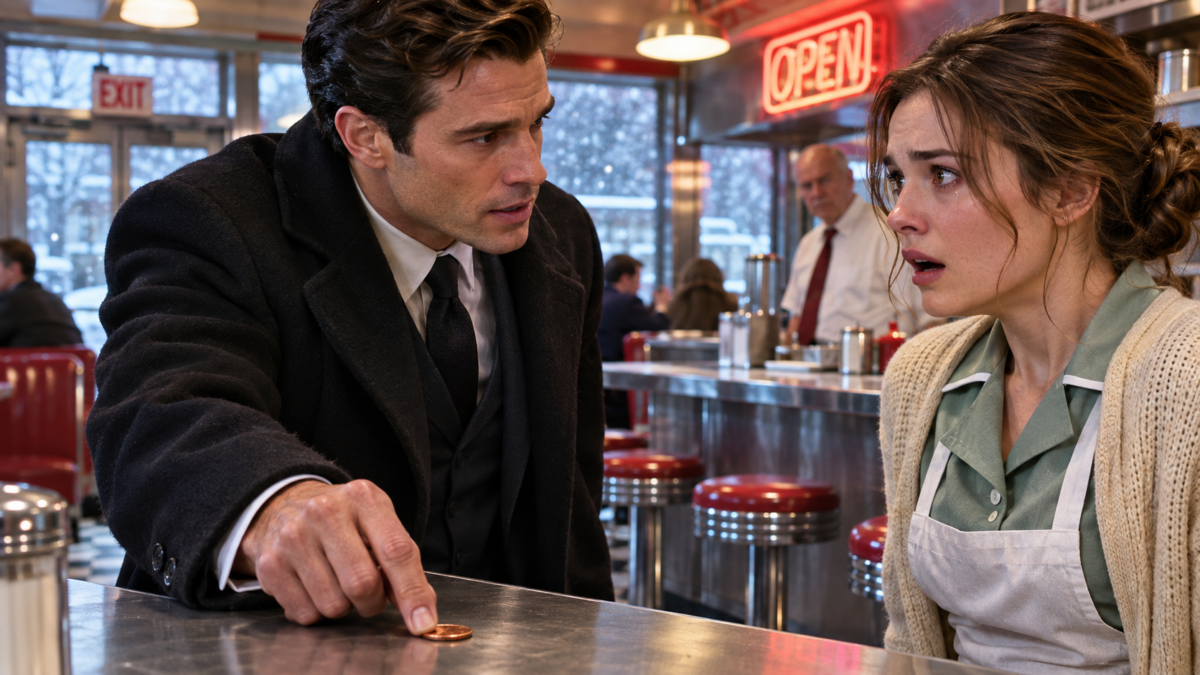
He wore a dark suit, a white shirt, a black tie and a long dark overcoat.
Unlike the regular customers who came in looking for food, this man appeared to be looking for a particular person.
He walked toward the counter and asked:
“Which one of you is Emily Parker?”
Emily looked up.
Her expression changed from concentration to surprise.
She was holding her brown wallet when she turned toward him.
“I am. Why?”
The stranger didn’t appear to be there to order a meal.
He had come with a purpose.
And the answer to Emily’s question was connected to the old man she had once helped.
The Coin That Brought Back a Memory
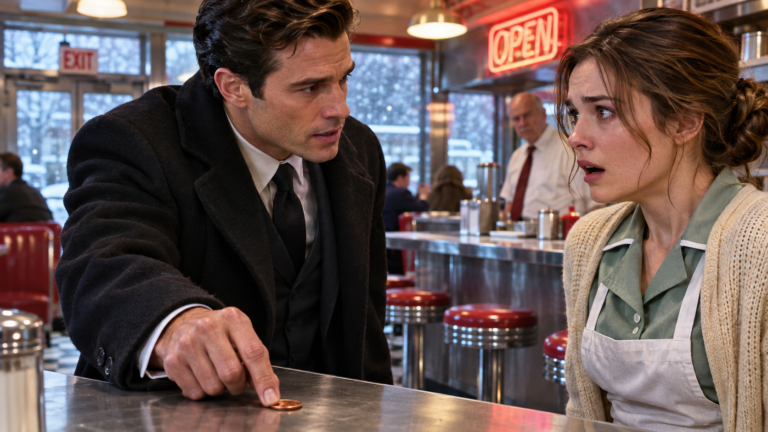
Standing across the counter from Emily, the man placed a copper-colored coin on the metal surface.
The movement echoed Walter’s earlier gesture.
A small coin.
The same kind of counter.
A young waitress who had offered kindness without expecting recognition.
Emily looked down.
Her expression shifted.
Something about the moment clearly caught her attention.
Then the man began to explain.
“Walter Bennett was my father.”
Those six words established the connection.
Walter was not simply an anonymous stranger to this man.
He was his father.
The son had come to the diner specifically because of what Emily had done for him.
And he had something more to say.
“I Came Here to Find the Woman…”
The man looked directly at Emily.
His voice was serious and controlled as he continued:
“I came here to find the woman who fed him with her last seven dollars.”
Emily stared at him.
She had offered Walter a meal in a moment of compassion.
Now his son was standing before her, telling her that he knew about it.
It wasn’t the amount of money that made the encounter extraordinary.
Seven dollars could disappear in a single ordinary purchase.
But Emily’s decision had meant enough to Walter that his son knew the story.
And that son had made the effort to find her.
For Emily, who had never acted as though she expected a reward, the revelation was overwhelming.
Her face filled the screen.
Her eyes widened.
Her lips parted slightly.
She looked stunned, as though she was struggling to understand how something so small had led to this moment.
What Happened Next?
The video ends there.
We don’t see the stranger offer Emily money.
We don’t see him hand her a check, promise her a job or reveal an inheritance.
We don’t learn exactly what brought him to the diner beyond his stated reason for looking for the woman who fed his father.
And we don’t see Emily’s response after the revelation.
Instead, the final moment belongs to her expression.
A young waitress who had given away her last seven dollars was now standing face-to-face with the son of the man she helped.
He knew her name.
He knew what she had done.
And he had come looking for her.
The unanswered questions make the ending even more moving.
What did Walter tell his son about Emily?
How did his son find her?
And what did he intend to say or do after introducing himself?
The short video leaves those possibilities open.
Why This Small Act of Kindness Matters
Stories about generosity often focus on enormous donations or dramatic acts of heroism.
But Emily’s story centers on something much smaller.
A bowl of soup.
A few dollars.
A quiet conversation between two people who seemed to be struggling in different ways.
Walter recognized that Emily needed the money.
Emily recognized that Walter needed food.
Neither person ignored the other’s hardship.
And that is what makes their exchange memorable.
Emily didn’t need to know Walter’s family history before helping him.
She didn’t ask what he could give her in return.
She simply chose to treat him with compassion.
Later, when his son returned to the diner, that decision became the center of an unexpected encounter.
The story offers a reminder that kindness doesn’t have to be expensive to matter.
Sometimes the smallest gift is the one someone remembers.
And sometimes, a person you helped for only a few minutes leaves a lasting impression on someone you haven’t even met.
Emily Parker gave Walter Bennett her last seven dollars.
But when his son came looking for her, she discovered that her kindness had not been forgotten.
The video doesn’t tell us what happened after that.
It leaves us with one unforgettable image: a young waitress standing in stunned silence while a stranger explains why he came to find her.
And one question worth asking:
If you had only seven dollars left, would you have done what Emily did?
Editor’s note: This article is a fictionalized narrative adaptation of a short dramatic video. The dialogue, meal, coin and son’s revelation come from the depicted story. The video ends with Emily’s shocked reaction; no later reward or outcome is established.