She Chose Her Biological Father for the Wedding—Then the Man Who Raised Her Handed Her the Bill
She wanted her biological father to walk her down the aisle. But the man who had been there for her since childhood was standing right in front of her, already holding the paperwork for her wedding. When she told him her decision, his response changed everything.
The living room was filled with warm light.
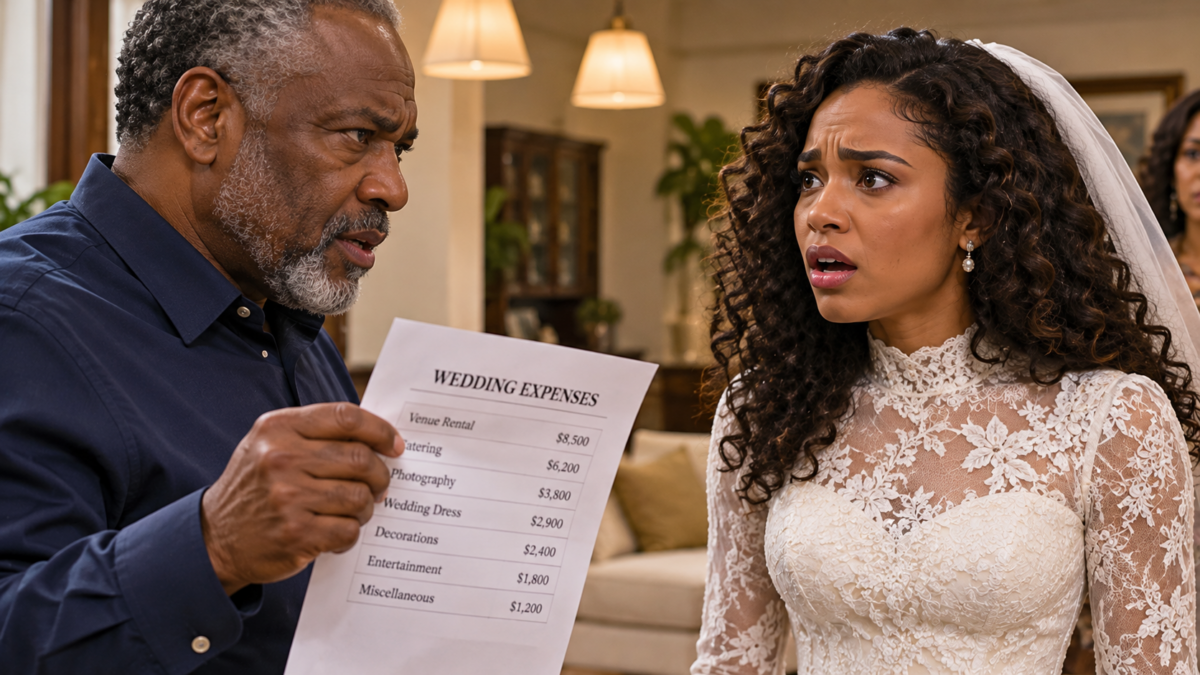
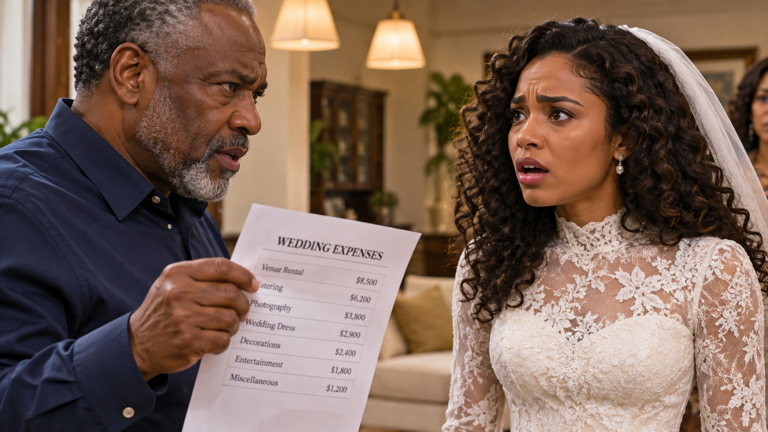
A young bride stood facing an older man.
She looked beautiful in an ivory-white wedding gown, with a high lace neckline, delicate floral embroidery and long transparent lace sleeves.
A white bridal veil fell behind her thick, naturally curly dark hair.
Everything about her appearance suggested that an important day was approaching.
But the atmosphere in the room was far from joyful.
Standing opposite her was an older man with short salt-and-pepper hair, a neatly trimmed beard and a dark navy-blue shirt.
He was holding several sheets of paper.
The documents contained information about wedding expenses.
He looked at the young woman as she prepared to tell him something important.
Then she spoke.
“I want my real dad to walk me down the aisle.”
The words were simple.
But their meaning was impossible to ignore.
A Wedding Decision That Hurt More Than She Expected
For many brides, walking down the aisle is one of the most emotional moments of a wedding.
It can symbolize love, family and the beginning of a new chapter.
But this bride’s choice created an immediate conflict.
She wanted her biological father to accompany her.
The older man standing in front of her had apparently expected something different.
His expression changed.
His eyes widened.
He stared at her in disbelief.
Then he asked a question filled with hurt.
“What? After everything I do for you?”
He didn’t sound like someone hearing a minor change in wedding arrangements.
He sounded like someone who felt that his years of involvement in her life had suddenly been overlooked.
And he wasn’t finished speaking.
“I’ve Been There for You Since You Were a Kid.”
The camera moved closer to the older man’s face.
His eyebrows tightened.
The lines around his eyes became more pronounced.
He looked directly at the bride.
Then he reminded her of something he believed should matter.
“I’ve been there for you since you were a kid.”
Those words carried the emotional weight of the confrontation.
According to the man, he had been part of her life since childhood.
He wasn’t merely someone helping with the wedding.
He was someone who believed his years of care and presence deserved recognition.
The short video doesn’t explain exactly how he came into her life.
It doesn’t establish whether he was legally her adoptive father or her stepfather.
But his own words make clear that he considered his role in raising her significant.
He had been there for her.
And now, as she prepared for one of the biggest moments of her adult life, she wanted another man to walk beside her.
It was a decision the older man clearly struggled to accept.
“Yeah, But He’s My Real Dad.”
The bride listened to his response.
Her thick dark curls framed her face, and the lace of her wedding dress caught the warm indoor light.
She remained facing him.
Then she answered.
“Yeah, but he’s my real dad.”
The sentence was short, but it changed the tone of the conversation.
The older man had spoken about being present throughout her childhood.
The bride responded by emphasizing her biological connection to the other man.
She wasn’t offering a compromise.
She wasn’t asking both men to walk with her.
In the conversation shown, she continued to insist that her biological father was the person she wanted beside her in the aisle.
The older man’s expression became increasingly serious.
And then he looked down.
The Papers He Had Been Holding All Along
The man lowered his eyes toward the documents in his hands.
The white papers had been visible since the beginning of the conversation.
They were not something he suddenly retrieved from a drawer.
He had already been holding them while listening to the bride.
Now he began adjusting the pages.
The camera moved closer.
Printed text appeared on the white paper.
Several lines listed wedding-related expenses and numerical amounts.
The documents appeared to concern the financial arrangements for the upcoming ceremony.
The exact total wasn’t clearly established in the video.
But the purpose of the paperwork was about to become unmistakable.
The older man raised one of the sheets toward the bride.
His expression remained firm.
Then he delivered a response that she clearly hadn’t expected.
“Have Your Real Dad Finish Paying for the Wedding.”
The man looked at the bride.
He held the expense document in front of him.
And he said:
“Well, have your real dad finish paying for the wedding.”
Suddenly, the conversation wasn’t only about who would walk down the aisle.
It was also about who would pay for the wedding.
The older man’s statement suggested that he had been contributing financially to the event.
He was now directing the remaining responsibility toward the biological father the bride had chosen.
For the bride, this appeared to be an unexpected consequence.
The man had not prevented her from choosing who would escort her.
Instead, he was making a separate decision about his own financial involvement.
The distinction was important.
And the bride seemed shocked by it.
The Bride’s Expression Changes
The camera returned to a close-up of the young woman.
Her eyes lowered toward the paperwork.
She seemed to be processing what she had just heard.
Only moments earlier, she had been discussing her wedding ceremony.
Now she was being confronted with the cost of that wedding.
Her expression shifted.
Her brows drew together.
She raised her eyes toward the older man.
Then she asked:
“So you’re stopping my wedding?”
Her question revealed how she understood his decision.
To her, his refusal to continue paying seemed like a threat to the plans she had already made.
But the older man didn’t agree with her interpretation.
And his final answer was even more direct than his previous statement.
“No, I’m Just Not Paying for It.”
The camera cut back to the older man.
He stood in the same room, still wearing his navy-blue shirt.
His expression was serious but controlled.
He looked at the bride and replied:
“No, I’m just not paying for it.”
There was no lengthy explanation.
No argument about the guest list.
No demand that the bride change her decision.
He simply clarified his own.
He wasn’t announcing that the ceremony had been canceled.
He wasn’t saying she was forbidden from getting married.
He was saying he would no longer provide the money.
His words separated two choices that the bride had seemingly treated as connected.
She could choose her biological father to walk her down the aisle.
And he could choose not to continue funding the wedding.
The exchange left the bride visibly stunned.
The Final Reaction Says Everything
The camera returned to the bride’s face.
Her eyes widened.
Her eyebrows lifted.
Her lips parted.
She looked directly toward the older man, apparently unable to believe what he had just said.
For a moment, she had no answer.
The video held on her shocked expression.
Then the screen went black.
There was no additional conversation.
No scene showing the biological father.
No announcement that the wedding was officially canceled.
No reconciliation between the bride and the man who had raised her.
The video ended with the financial decision hanging in the air.
And that unresolved ending made the confrontation even more powerful.
Was the Older Man Right?
The story raises a difficult question about family relationships.
What matters more: biological connection or the years someone spends caring for another person?
The bride clearly valued the fact that the other man was her biological father.
She wanted him to walk her down the aisle.
That was her stated preference.
But the older man believed that his role in her childhood deserved acknowledgment.
He had been present.
He had helped raise her.
And, according to his final decision, he had also been financially involved in the wedding.
From his perspective, her choice appeared deeply hurtful.
From another perspective, the bride had the right to decide who would accompany her at her ceremony.
The conflict comes from those two expectations colliding.
The bride wanted freedom over the symbolic role in her wedding.
The older man wanted the freedom to decide whether he would continue paying for it.
Neither the video nor its ending tells us how the wider family ultimately resolved those competing expectations.
A Wedding Bill That Revealed a Bigger Conflict
The printed wedding-expense document was a small but important part of the scene.
It was present from the beginning.
Yet the bride didn’t appear to anticipate what the older man would do with it.
The paperwork became central only after she reaffirmed her preference for her biological father.
At that moment, the older man stopped arguing about the aisle.
He turned the conversation toward the financial commitment he had made.
His final words were not an attempt to physically prevent the ceremony.
They were a refusal to keep paying.
That distinction is what makes the ending memorable.
The bride could still want her biological father by her side.
But she could no longer assume that the man who had raised her would continue covering the wedding expenses.
At least, that was the decision he communicated.
The Question Left Unanswered
The bride’s shocked expression is the final image.
We don’t know whether she changed her mind.
We don’t know whether her biological father agreed to pay the remaining costs.
We don’t know whether the wedding proceeded as planned.
And the video doesn’t reveal whether the two people eventually reconciled.
What it shows is a painful moment when a family decision and a financial decision become inseparable.
She chose the man she called her real father to walk her down the aisle.
The man who had raised her chose not to continue paying.
And when she asked whether he was stopping her wedding, his answer was unmistakable:
“No, I’m just not paying for it.”
Sometimes, the most powerful response isn’t an angry speech.
It’s a simple decision that forces everyone involved to reconsider what they expected from one another.
Was he justified in refusing to pay, or should his support have remained unconditional?
That’s the question this wedding confrontation leaves behind.
Editor’s note: This article is a fictionalized narrative adaptation of a short dramatic video. The bride’s decision, the older man’s statements, the wedding-expense paperwork and the final shocked reaction are depicted in the source. The precise legal relationship between the characters, the total wedding costs and what happens afterward are not established.