**“WHICH ONE OF YOU IS EMILY PARKER?”**

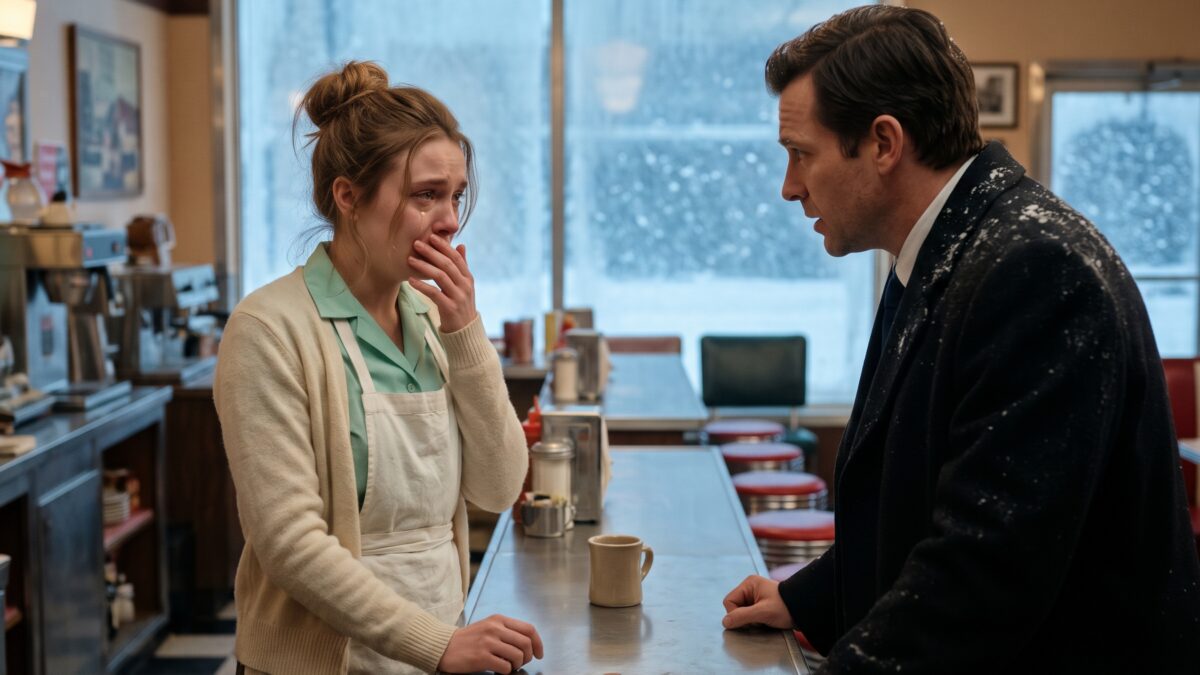
The deep voice made everyone inside the little roadside diner turn around.

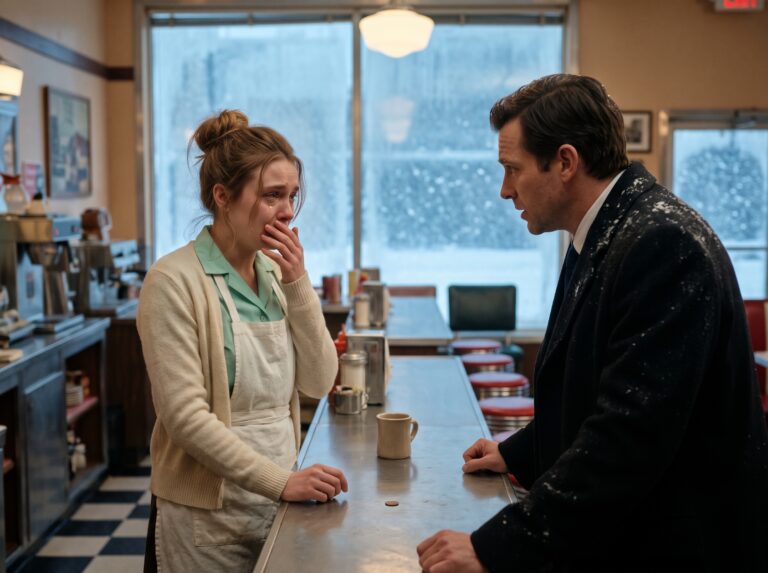
A tall man in a black overcoat stood near the entrance.

His expensive suit and polished shoes seemed completely out of place among the worn red booths and black-and-white checkered floor.

Behind the counter, twenty-five-year-old Emily Parker froze.

Her brown hair was tied into a messy bun, and a cream cardigan covered her faded sage-green uniform.

She had been counting the few dollars left in her wallet.

Now a stranger was asking for her by name.

Emily stepped forward.

**“I am. Why?”**

The man studied her face.

Then he reached into his coat pocket and placed a small copper coin on the stainless-steel counter.

Emily recognized it immediately.

Her heart began to race.

She had seen that exact coin the previous evening.

It belonged to a homeless-looking old man with a long white beard.

A man who had entered the diner hungry, exhausted, and shivering from the cold.

His name was Walter Bennett.

And Emily had given him the last seven dollars she owned.

The stranger looked directly into her eyes.

**“My dear, Walter Bennett was my father.”**

Emily's lips parted.

The man continued, his voice filled with emotion.

**“I came here to find the woman who fed him her last seven dollars.”**

Emily stared at the coin.

She had expected nothing in return for helping Walter.

But the stranger wasn't there merely to thank her.

**He had brought a secret that connected his father to Emily's family—and a promise that had remained unfulfilled for twenty-six years.**

---

### THE GIRL WHO COULDN'T AFFORD TO BE KIND

Emily had worked at Rosewood Diner for almost five years.

The restaurant stood beside a quiet highway outside a small Pennsylvania town.

It wasn't fancy.

The metal counter had scratches from decades of use.

The red vinyl booths were beginning to crack.

And the old neon sign flickered whenever it rained.

But to Emily, the diner felt like home.

Her father, James Parker, had worked there as a cook for more than thirty years.

When Emily was little, he used to sit her on a stool near the kitchen and give her pancakes shaped like hearts.

He taught her how to make coffee, how to greet customers, and how to recognize when someone needed help without being asked.

James died three years earlier.

Since then, Emily had struggled to support herself and her mother, who was recovering from a serious illness.

Medical bills had accumulated.

Rent was overdue.

And the diner had recently reduced everyone's working hours because business was slow.

That Wednesday evening, Emily had exactly seven dollars in her wallet.

Her paycheck wouldn't arrive until Friday.

She needed those seven dollars for groceries.

But when Walter Bennett walked through the door, something in his eyes made her forget her own problems.

---

### THE OLD MAN NOBODY WANTED TO SERVE

Walter looked about seventy-five.

He wore a dark knitted hat and a faded coat that hung loosely from his thin shoulders.

His white beard reached almost to his chest.

His hands were trembling.

He sat at the counter without ordering anything.

A few customers glanced at him and quickly looked away.

One man wrinkled his nose.

Another moved farther down the counter.

Emily approached gently.

She asked whether he was hungry.

Walter looked at the menu.

Then at the prices.

He admitted that he didn't have enough money for a meal.

Emily noticed how carefully he spoke, as if he was embarrassed to admit it.

She disappeared into the kitchen.

A few minutes later, she returned with a steaming bowl of chicken noodle soup.

She placed it before him with a spoon and a piece of bread.

Walter stared at the food.

He asked how much he owed.

Emily opened her brown leather wallet.

There was one crumpled bill inside.

She placed it beside the bowl.

**Seven dollars.**

The last money she had until payday.

Walter looked at her in disbelief.

Emily smiled softly.

**“You need that money more than I do.”**

The old man's eyes filled with tears.

He hadn't expected kindness.

Not from someone who clearly had so little herself.

He picked up his spoon and began eating slowly.

Emily stayed nearby, making sure he had enough water.

At one point, Walter looked at her with an expression she couldn't understand.

It was as though she had reminded him of someone he had known a very long time ago.

Before leaving, he placed a small copper coin beside his stained coffee cup.

Emily tried to return it.

But Walter shook his head.

He wanted her to keep it.

Then he walked out through the glass door and disappeared down the street.

Emily watched him go.

She never expected to see the coin again.

---

### THE SON WHO HAD BEEN SEARCHING FOR HIS FATHER

The man in the black coat introduced himself as Nathan Bennett.

He was thirty-four years old.

He explained that Walter had left his home unexpectedly several days earlier.

After the death of Nathan's mother, Walter had withdrawn from family life.

He rarely went out.

He often spent hours looking through old photographs.

Sometimes he talked about people Nathan had never met.

A few days before disappearing, Walter had mentioned a place called Rosewood Diner.

He said there was something he needed to put right before it was too late.

Nathan had assumed his father was simply reminiscing.

But when Walter stopped answering his phone, Nathan became worried.

He began searching for him.

Late the previous evening, Walter finally contacted him from a nearby shelter.

He was safe.

He had eaten.

And he couldn't stop talking about a young waitress named Emily Parker.

Nathan asked why this woman mattered so much.

Walter gave an answer that left his son speechless.

**“Because twenty-six years ago, another Parker saved my life.”**

---

### THE STORY OF TWO MEN AND SEVEN DOLLARS

In 2000, Walter Bennett was not a wealthy man.

He was forty-nine years old, unemployed, and struggling to support his wife and young son.

A small manufacturing business he had started had failed.

He had lost his savings.

His house was close to foreclosure.

After weeks of unsuccessful job interviews, Walter found himself sitting at the counter of Rosewood Diner.

He hadn't eaten properly in two days.

His wallet contained almost nothing.

That evening, a young cook noticed him.

The cook was James Parker.

Emily's father.

James was exhausted from a twelve-hour shift.

His wife had recently given birth to their daughter.

Money was tight.

But James still brought Walter a bowl of soup.

When Walter explained that he couldn't pay, James quietly took seven dollars from his own pocket.

It was all the cash he had left.

He placed the money on the counter and told the cashier the meal was covered.

Walter was overwhelmed.

He tried to refuse.

But James insisted that no one should have to go hungry simply because life had become difficult.

Before leaving, Walter reached into his pocket.

He found an old copper penny.

It had been his lucky coin since childhood.

He offered it to James as a promise that he would repay the kindness someday.

James laughed gently.

He told Walter to keep it.

Then he said something Walter would never forget.

**“One day, when you can, do something good for somebody else.”**

Walter left the diner that night with food in his stomach and a little hope in his heart.

A week later, he found work.

Within several years, he rebuilt his career.

Eventually, he became the owner of a successful regional logistics company.

But the memory of James Parker never left him.

---

### THE PROMISE HE COULDN'T FULFILL

Walter had tried to return to the diner many years later.

But by then, James had moved to another restaurant temporarily.

Walter couldn't find him.

His business responsibilities grew.

His family moved.

And time passed faster than he expected.

He kept the copper penny in a small wooden box beside his bed.

Sometimes, when Nathan complained about difficult customers or employees, Walter showed him the coin.

He explained that the smallest act of kindness could change someone's entire life.

Nathan listened.

But as a young man, he didn't fully understand what his father meant.

Then Walter's wife died.

The loss shook him deeply.

He began thinking about unfinished promises.

People he should have thanked.

Words he had never said.

And the cook who had fed him when he had nothing.

Walter decided to return to Rosewood Diner.

He wore the old coat he had kept from his difficult years.

Not to disguise himself or test anyone.

He simply found comfort in familiar belongings.

When he entered the diner, he was tired, cold, and genuinely hungry.

He didn't know whether James still worked there.

He had planned to ask about him after ordering a meal.

But before he could explain why he had come, a young waitress brought him soup.

Then she gave him seven dollars.

The very same amount James had spent to help him twenty-six years earlier.

And when Walter noticed her name badge, he nearly burst into tears.

**EMILY PARKER.**

The surname.

The kindness.

The familiar smile.

It felt as though the past had suddenly returned.

---

### THE PHOTOGRAPH INSIDE THE OLD WALLET

Nathan reached into his coat again.

This time, he brought out a faded photograph.

It showed two men standing in front of Rosewood Diner.

One was Walter, younger and clean-shaven.

The other wore a cook's apron.

Emily recognized him immediately.

**Her father.**

She pressed a hand to her mouth.

The photograph had been taken several months after Walter first visited the diner.

He had returned to thank James before their paths separated again.

On the back, written in her father's familiar handwriting, were six words:

**“Good people never forget to help.”**

Emily began to cry.

For three years, she had missed hearing her father's voice.

She had worried that she was failing to live up to the values he had taught her.

And now a stranger stood before her with proof that James's compassion had reached far beyond their small town.

Nathan watched her quietly.

Then he told her something Walter had asked him to say.

His father had wanted to thank James in person.

When he learned that James had died, he was devastated.

But he felt that meeting Emily had given him one final opportunity to express his gratitude.

---

### THE REASON NATHAN CAME BACK

Emily wiped her tears.

She thanked Nathan for sharing the story.

She told him that she hoped Walter was doing well.

Nathan explained that his father was safe and resting.

He would be returning home later that day.

Then Nathan looked around the diner.

He noticed the broken stool near the entrance.

The flickering lights.

The handwritten sign announcing reduced opening hours.

He asked Emily whether the business was struggling.

She hesitated.

Then she admitted that the owners had been discussing whether they could afford to keep it open.

The building needed repairs.

Business was declining.

And several longtime employees feared losing their jobs.

Nathan listened carefully.

He had grown up in a family business.

He understood that a restaurant couldn't survive on goodwill alone.

But he also understood that places like Rosewood Diner mattered.

They gave people work.

They provided inexpensive meals.

And sometimes, they offered a warm place to sit when someone had nowhere else to go.

Nathan asked whether he could speak to the owner.

Emily assumed he wanted to buy something.

She had no idea what he was planning.

---

### A GIFT THAT WASN'T ABOUT THE MONEY

Over the following weeks, Nathan worked with the diner's owners to develop a realistic plan for keeping the restaurant open.

His company provided logistical support for local food deliveries.

He helped them negotiate more affordable supply arrangements.

And he connected them with a small-business adviser who could review their finances.

Nathan also offered to sponsor a community meal program in his father's name.

It would provide prepaid meals for people experiencing hardship.

The program was designed to operate without embarrassing anyone who needed it.

There would be no public announcements.

No photographs of struggling customers.

No demands that people explain their circumstances in front of strangers.

Just a warm meal when it was needed.

Emily helped organize the program.

She suggested that customers could quietly contribute the cost of an extra meal whenever they were able.

Some donated five dollars.

Others ten.

A few paid for entire weeks.

Soon, a simple handwritten sign appeared near the register:

**“IF YOU NEED A MEAL, PLEASE ASK. SOMEBODY HAS ALREADY PAID.”**

The idea spread through town.

And Rosewood Diner slowly began filling with customers again.

---

### THE DAY WALTER RETURNED

One Saturday morning, the diner was unusually busy.

Emily was carrying plates when the glass door opened.

An elderly man stepped inside.

He wore a clean navy coat and leaned lightly on a walking stick.

His white beard was neatly combed.

For a moment, Emily didn't recognize him.

Then she saw his eyes.

**Walter Bennett.**

He smiled.

Nathan stood beside him.

Emily hurried around the counter.

Walter looked healthier, although his steps were still slow.

He thanked her for the soup.

For the seven dollars.

And for treating him like a person when he had felt invisible.

Emily told him he had nothing to repay.

But Walter shook his head.

He explained that twenty-six years earlier, James had said exactly the same thing.

Walter took a copper penny from his pocket.

He placed it on the counter.

Then he looked at Emily and smiled.

The coin had never been valuable.

But for Walter, it had become a reminder that even the hardest seasons of life could end.

Emily gently pushed it back toward him.

She wanted him to keep it.

Walter looked at Nathan.

Then at the handwritten meal-program sign.

He understood that the promise had already been fulfilled.

Not through a grand reward.

But through a place where kindness could continue.

---

### ONE YEAR LATER

A year after Walter first walked into Rosewood Diner, Emily was still working behind the stainless-steel counter.

But life was different.

The restaurant had been repaired.

The neon sign worked again.

The booths had been restored.

And a small community board displayed photographs of former employees and longtime customers.

In the center was a picture of James Parker.

Beside it hung the photograph Nathan had brought that unforgettable morning.

Underneath were two dates.

**2000 — JAMES HELPED WALTER.**

**2026 — EMILY HELPED WALTER.**

One afternoon, Emily noticed a young father sitting alone at the counter.

He was staring at the menu.

His wallet lay open in front of him.

He looked worried.

Emily approached with a gentle smile.

She explained that someone had already paid for a meal if he needed one.

The man's eyes filled with tears.

He quietly accepted.

As Emily carried a bowl of soup toward him, she remembered her father.

She remembered Walter.

And she remembered the seven dollars she had given away when she couldn't afford to lose them.

**She had believed she was simply helping a hungry stranger.**

**She never imagined that twenty-six years earlier, her own father had shown that same stranger an identical kindness.**

And when Walter's son walked into the diner carrying a copper coin, she discovered something money could never measure.

**Kindness doesn't always return to the person who gives it.**

**Sometimes, it travels through years, families, and strangers before finding its way home.**

Emily placed the soup in front of the young father.

Then she smiled.

Because the greatest inheritance James Parker had left his daughter wasn't money.

**It was a heart that knew how to help someone, even when it had almost nothing left to give.