The afternoon sunlight filtered through the tall trees surrounding a beautiful estate in Connecticut.
A black luxury sedan had pulled up near a quiet garden courtyard.
Standing beside the car was Richard Harrison, a forty-six-year-old businessman whose name appeared regularly in financial magazines.
He was wealthy, successful, and respected.
But there was one thing all his money had failed to bring back.
His daughter’s happiness.
Richard was about to leave for another meeting when he noticed something near the garden.
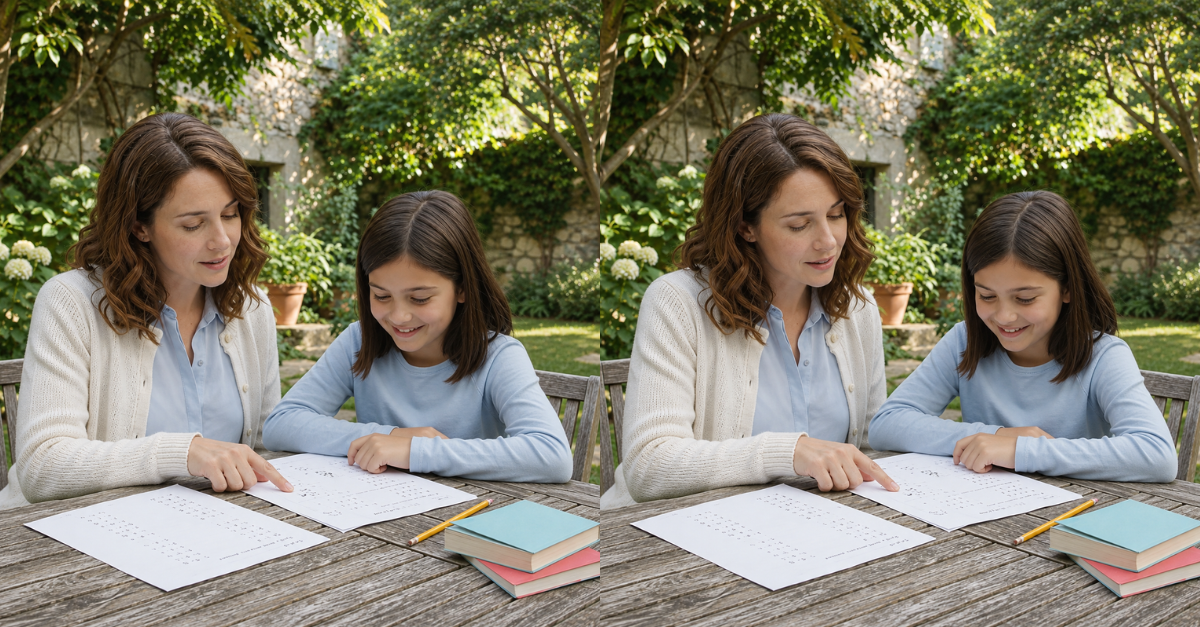
A young woman was sitting at a wooden table with his ten-year-old daughter, Sophie.
Several mathematics worksheets were spread between them.
The woman leaned towards Sophie and pointed at a problem.
“Don’t just memorize the steps, Sophie. Look for the pattern.”
Richard stopped.
Something about those words sounded strangely familiar.
Sophie frowned at her worksheet.
She studied the numbers carefully, erased part of her answer, and tried again.
Then her eyes widened.
“Oh, that’s why I kept getting it wrong!”
She burst into laughter.
It was a bright, delighted laugh.
The kind that came from discovering something wonderful.
And Richard felt his heart stop for a moment.
“Her laugh,” he whispered. “I haven’t heard that sound in two years.”
He stood motionless.
Two years.
That was how long it had been since Sophie had laughed so freely.
Two years since the day their family had changed forever.
Before everything happened, Sophie had been a cheerful, curious child.
She loved puzzles, mathematics, astronomy, and asking questions that adults sometimes struggled to answer.
Her mother, Evelyn Harrison, had been a mathematics teacher.
Every evening, mother and daughter would sit together at the kitchen table.
Evelyn had a special way of teaching.
She never encouraged Sophie to memorize a solution without understanding it.
Instead, she taught her to search for patterns.
“Every difficult problem has a secret,” she used to say. “You just have to look carefully enough to find it.”
Sophie adored those lessons.
And Richard adored listening to their laughter from the next room.
But two years earlier, Evelyn had passed away following a serious illness.
Sophie had never been quite the same.
She still went to school.
She still completed her homework.
She still answered when someone spoke to her.
But the joyful little girl Richard remembered seemed to have disappeared.
He tried everything he could think of.
Family holidays.
New hobbies.
Expensive presents.
Trips to places Sophie had always wanted to visit.
Nothing worked.
His daughter thanked him politely, then returned to her quiet routines.
Richard eventually stopped asking whether she was happy.
He was frightened of hearing the answer.
Now, standing beside his car, he watched Sophie laugh again.
The young woman smiled.
“Now try this one.”
She slid another worksheet across the table.
“It looks hard, but it follows the same logic.”
Richard stared at her.
Those words.
That method.
There was something unmistakably familiar about the way she taught.
He approached the table.
Sophie looked up.
“Dad?”
Richard smiled.
“Hello, sweetheart.”
“You’re home early.”
“I was just leaving, actually.”
He glanced at the worksheet.
“May I ask something?”
The young woman looked up politely.
“Of course.”
Richard pointed towards the calculations.
“Who taught you to solve equations like this?”
The woman froze.
For a moment, her smile disappeared.
Then she answered quietly.
“A teacher I knew a long time ago.”
Richard studied her face.
“What was her name?”
The woman hesitated.
“Evelyn Harrison.”
The world seemed to fall silent.
Richard stared at her.
“Evelyn?”
“Yes.”
“My wife?”
The young woman slowly nodded.
Her name was Emily Carter.
She was twenty-eight years old and had recently begun working as a private mathematics tutor.
But twelve years earlier, her life had been very different.
Emily had grown up in a struggling household.
Her father worked long hours, and her mother cleaned offices in the evening.
Emily loved mathematics, but she had difficulty understanding the way it was taught at school.
Her teachers often told her to memorize the formulas.
She tried.
She studied.
She practiced.
But she continued making mistakes.
One afternoon, overwhelmed by another failed test, she sat alone in an empty classroom.
Evelyn Harrison found her there.
“What’s wrong?” Evelyn asked.
Emily wiped her eyes.
“I’m just not clever enough.”
Evelyn sat beside her.
“Who told you that?”
Emily shrugged.
“Everyone keeps explaining the steps, but I don’t understand why they work.”
Evelyn smiled.
“Then perhaps we should stop memorizing the steps.”
She took a pencil and drew a simple pattern on a sheet of paper.
“Let’s look for what connects everything.”
For the next hour, they worked together.
And something extraordinary happened.
For the first time, Emily understood.
She discovered that mathematics wasn’t simply about remembering rules.
It was about recognizing relationships.
That afternoon changed her life.
Evelyn continued helping Emily long after the school day ended.
When Emily’s family struggled to afford educational materials, Evelyn found books she could borrow.
When Emily doubted herself, Evelyn encouraged her.
When she considered abandoning her dream of attending university, Evelyn helped her apply for scholarships.
Years later, Emily graduated with a mathematics degree.
She became a teacher because she wanted other children to experience the same moment of understanding Evelyn had given her.
But before she could thank her properly, Evelyn became ill.
Emily visited her former teacher shortly before she passed away.
Evelyn gave her a small notebook filled with handwritten mathematical puzzles.
On the first page, she had written:
Don’t teach children to fear difficult questions. Teach them to be curious enough to explore them.
Emily treasured that notebook.
And wherever she taught, she carried Evelyn’s lessons with her.
Richard listened without speaking.
Sophie looked from her father to Emily.
“You knew my mom?”
Emily nodded gently.
“I did.”
“Was she a good teacher?”
Emily smiled.
“She was the best teacher I ever had.”
Sophie looked down at her worksheet.
“Mom used to tell me to look for patterns.”
“I know,” Emily replied softly.
Richard cleared his throat.
“How did you end up teaching Sophie?”
Emily hesitated.
“A tutoring agency contacted me about a child who had been struggling with mathematics. When I saw her name, I wondered whether she might be Evelyn’s daughter.”
“Why didn’t you tell us?”
“I wasn’t certain at first. And once I realized, I didn’t want Sophie to feel that I was only here because I knew her mother.”
Emily glanced at the girl.
“I wanted her to enjoy learning again, at her own pace.”
Richard felt tears gathering in his eyes.
For two years, he had been searching for some grand solution to his daughter’s sadness.
He had believed that if he could buy the right experience, arrange the perfect holiday, or find the best specialist, he might somehow bring back the Sophie he remembered.
Yet here she was, smiling over an ordinary mathematics worksheet.
Not because someone had given her something expensive.
But because someone had helped her rediscover something she loved.
Sophie turned towards Emily.
“Can I ask you something?”
“Anything.”
“Do you think Mom would be proud of me?”
Emily looked at the worksheet.
“Absolutely.”
“Even though I kept getting the answers wrong?”
Emily shook her head.
“Especially because you kept trying.”
Sophie smiled.
Then she whispered:
“I miss doing math with her.”
Emily reached into her bag.
“I brought something today. I wasn’t sure whether I should show you yet.”
She took out Evelyn’s notebook.
Richard immediately recognized the handwriting on the cover.
He had seen that little blue notebook many times.
“Where did you get that?” he asked.
“Evelyn gave it to me.”
Emily opened the first page.
Inside was a photograph of Evelyn standing beside a younger Emily in a school classroom.
Sophie stared at it.
“That’s Mom!”
“Yes.”
“And that’s you?”
Emily laughed softly.
“I looked rather different back then.”
Sophie carefully touched the edge of the photograph.
For a moment, nobody spoke.
Then Emily turned a page.
“Would you like to see one of the puzzles your mother made?”
Sophie nodded eagerly.
Emily pointed to a series of numbers.
“Look closely. What do you notice?”
Sophie studied the pattern.
She frowned.
Then she smiled.
“Oh! I think I know!”
Richard watched his daughter pick up her pencil.
And once again, she began to laugh.
That evening, Richard canceled his business dinner.
Instead, he joined Sophie and Emily at the garden table.
For the first time in years, he allowed his schedule to wait.
Sophie explained the mathematical puzzle to him.
She spoke quickly, excitedly, waving her pencil as she demonstrated how the numbers connected.
Richard understood very little of her explanation.
But he didn’t care.
He had missed the sound of her enthusiasm more than he could ever explain.
When Emily prepared to leave, Richard walked with her towards the garden gate.
“I don’t know how to thank you,” he said.
Emily shook her head.
“You don’t owe me anything.”
“You brought my daughter’s laughter back.”
Emily glanced towards the table, where Sophie was still working.
“I didn’t give her something she didn’t have, Mr. Harrison.”
Richard looked at her.
“I simply helped her find a part of herself that was still there.”
Richard remained silent for a long moment.
Then he asked:
“Would you consider continuing to teach her?”
Emily smiled.
“I’d be delighted.”
Over the following months, Sophie’s confidence gradually returned.
Some days were easier than others.
She still missed her mother.
Sometimes a familiar song or photograph made her quiet again.
But she began speaking more openly about how she felt.
She laughed more often.
She invited friends over.
And she returned to the puzzles she had once enjoyed.
Richard also changed.
He stopped assuming that every difficult feeling needed an immediate solution.
Instead, he learned to make time for his daughter.
They began spending one evening each week solving mathematics puzzles together.
Richard was terrible at them.
Sophie found that hilarious.
And he loved every second.
Six months later, Sophie entered a school mathematics competition.
She didn’t win first prize.
She finished third.
But when she came off the stage, Richard was waiting for her.
“I’m sorry I didn’t win, Dad,” she said.
Richard knelt beside her.
“Why would you apologize?”
“Because you came all this way.”
He smiled.
“Sophie, I didn’t come to watch you win.”
“Then why?”
“I came to watch you enjoy doing something you love.”
She threw her arms around him.
And Richard finally understood what Evelyn had been trying to teach both of them all those years.
On what would have been Evelyn’s birthday, Richard and Sophie invited Emily to dinner.
After the meal, Sophie placed three notebooks on the table.
One belonged to her mother.
One belonged to Emily.
And the third was brand new.
She had written a title on its cover:
THE PATTERN CONTINUES.
Richard smiled.
“What’s this one for?”
Sophie answered proudly:
“It’s for all the things we’re going to learn together.”
Emily’s eyes filled with tears.
Richard opened Evelyn’s old notebook one last time.
On the final page, he found a sentence he had never noticed before.
The most beautiful thing about teaching is that what you give to one child may someday reach another.
He looked at Emily.
Then at Sophie.
And suddenly, everything made sense.
Evelyn was gone.
Nothing could change that.
But the kindness she had shown a struggling student years earlier had found its way back to her own daughter.
Richard closed the notebook gently.
“Your mother would have loved this,” he whispered.
Sophie smiled.
Then she laughed.
And this time, Richard didn’t think about the two years of silence.
He simply listened.
Because sometimes the greatest gift a person leaves behind isn’t money, property, or fame. It’s the kindness they pass on to someone else — kindness that may one day return when it’s needed most.
THE END.