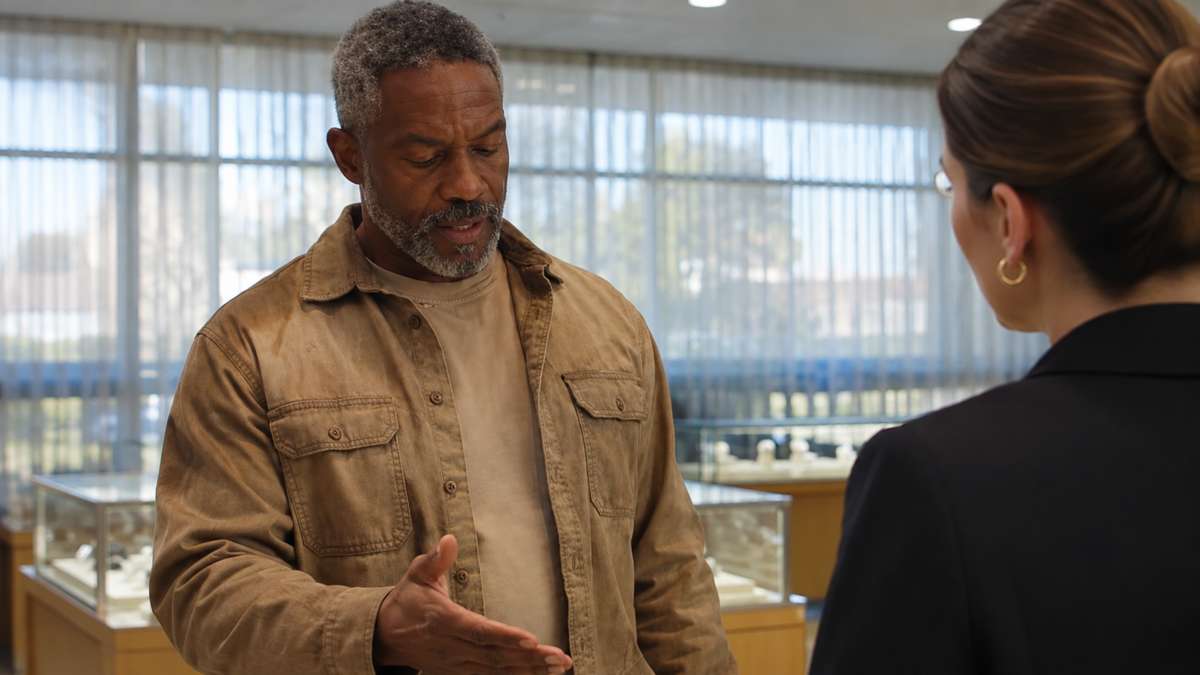
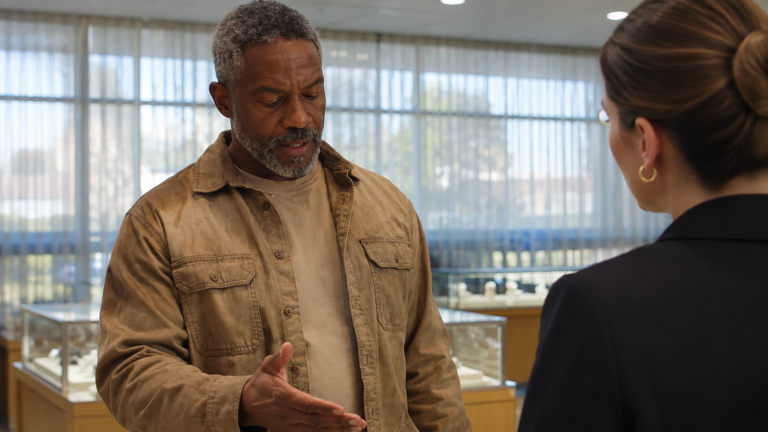
“I’d like to see that watch.”
The elderly man’s gentle voice echoed through the luxurious Carter & Sons watch boutique in downtown Manhattan.
Behind the glass counter stood Vanessa Brooks, a twenty-eight-year-old saleswoman wearing an elegant black suit.
She glanced at the man standing before her.
He appeared to be around sixty-five years old, with short gray hair, a salt-and-pepper beard, and a faded brown jacket.
His shoes were worn, and his clothes looked inexpensive.
Vanessa frowned.
“Which watch?”
The man pointed toward a beautiful platinum timepiece displayed beneath the glass.
“That one, please.”
Vanessa folded her arms.
“That watch costs $40,000.”
The elderly man smiled politely.
“I know. May I see it?”
Vanessa rolled her eyes.
“Sir, you’re wasting my time. People dressed like you don’t buy watches like that.”
Several customers turned toward them.
The man remained calm.
“I’m here to buy it.”
Vanessa laughed.
“Then go somewhere else. You’re making my customers uncomfortable.”
The showroom fell silent.
The elderly man slowly lowered his hand.
For a moment, sadness crossed his face.
But before he could respond, another employee hurried toward them.
His name was Daniel Mitchell, the boutique’s thirty-five-year-old assistant manager.
“Mr. Carter, welcome back!”
Vanessa turned sharply.
“You know him?”
Daniel looked confused.
“Of course.”
He glanced at the elderly man, then back at Vanessa.
“He’s the owner of this store.”
Vanessa’s face turned white.
“What?”
The elderly man was William Carter, founder and majority owner of Carter & Sons, a luxury watch company operating twenty-seven boutiques across the United States.
William looked directly at Vanessa.
His voice was calm but firm.
**“And you just lost your job because you judged me before knowing me.”**
Vanessa stood frozen.
Her mouth opened, but no words came out.
The customers watched in stunned silence.
Finally, she whispered:
“Mr. Carter… I didn’t know.”
William nodded sadly.
“That was the problem.”
***
Forty years earlier, William Carter had been a poor young watchmaker working in a tiny repair shop.
He had grown up in a struggling neighborhood, where his mother cleaned offices and his father repaired broken appliances.
William loved watches from childhood.
He was fascinated by the idea that hundreds of tiny pieces could work together to measure time.
At nineteen, he began repairing old watches in his father’s garage.
Most customers couldn’t afford expensive repairs.
Sometimes William fixed their watches for free.
His father often warned him:
“Son, kindness won’t pay the bills.”
William would smile.
“Maybe not, Dad. But people remember how you treat them.”
When he opened his first boutique, he had only $1,200 in savings.
He couldn’t afford elegant displays or expensive furniture.
His first store had secondhand shelves and a small wooden counter.
But William believed that every customer deserved the same respect.
Whether someone wanted a five-dollar repair or a thousand-dollar watch, he treated them equally.
Over the following decades, his business expanded.
He became a millionaire.
Then his company grew into an international luxury brand.
But William never forgot where he came from.
He continued wearing simple clothes and driving an old pickup truck.
His favorite jacket was the same brown coat his late wife, Margaret, had bought him twenty years earlier.
She had died five years ago.
William kept the jacket because it reminded him of the woman who believed in him when he had nothing.
***
Three months before the incident, William had received several troubling customer complaints.
Some customers claimed they were ignored because of their clothing.
Others said employees treated them rudely unless they wore expensive jewelry.
One elderly customer wrote:
*“I entered your store hoping to purchase a retirement gift for my wife. Your employee told me I should try a cheaper shop.”*
William was heartbroken.
The company he had built around dignity and kindness was slowly becoming something he no longer recognized.
He decided to visit several boutiques anonymously.
He wore his old jacket, carried a simple wallet, and avoided announcing his arrival.
Most stores passed his test.
But the Manhattan boutique was different.
Several employees ignored him.
And Vanessa humiliated him openly.
Yet the story didn’t end with her dismissal.
***
After the confrontation, Vanessa followed William into his private office.
Tears streamed down her face.
“Mr. Carter, please! I need this job!”
William sat behind his desk.
“Why did you speak to me that way?”
Vanessa lowered her eyes.
“I thought you couldn’t afford the watch.”
“And why did that matter?”
She hesitated.
“Because we’re expected to focus on serious buyers.”
William leaned forward.
“Who told you that?”
Vanessa swallowed.
“Our store manager.”
William frowned.
“Richard?”
She nodded.
“He tells us not to waste time on customers who don’t look wealthy.”
William remained silent.
Then he asked:
“Has he instructed other employees to do the same?”
Vanessa nodded again.
“He says appearances tell us everything we need to know.”
William felt a wave of disappointment.
Richard Collins had managed the Manhattan boutique for eight years.
William had trusted him completely.
Now he discovered that Richard had been teaching employees to discriminate against customers.
But there was something even more disturbing.
Vanessa opened her handbag and removed a small notebook.
“I’ve been keeping records,” she whispered.
William looked surprised.
“Records of what?”
“Customer complaints that Richard told us to delete.”
William stared at her.
“Delete?”
Vanessa nodded.
“He said negative reviews would damage our bonuses.”
She handed him the notebook.
Inside were dates, names, and descriptions of dozens of incidents.
Some involved elderly customers.
Others concerned people wearing casual clothes.
William read the pages carefully.
His expression grew increasingly serious.
“Why didn’t you report this?”
Vanessa began crying.
“I was afraid of losing my job.”
William looked at her.
“But you were willing to humiliate someone else to protect it?”
She lowered her head.
“Yes.”
He sighed.
“That doesn’t excuse what you did.”
“I know.”
***
The following morning, William called an emergency meeting with the company’s human resources director and regional executives.
They reviewed security footage, customer complaints, and employee statements.
The investigation revealed that Richard had created an aggressive sales environment.
Employees were pressured to judge customers by appearance.
Several workers admitted they feared punishment for spending time with anyone who seemed unlikely to make a large purchase.
Richard had also concealed complaints from corporate headquarters.
William was furious.
“This company was never built to make people feel inferior.”
Richard tried to defend himself.
“I was only trying to improve sales!”
William shook his head.
“Sales without integrity are worthless.”
Richard was dismissed from his managerial position following the investigation.
The company began reviewing its customer-service policies.
But Vanessa’s situation was more complicated.
Her behavior had been unacceptable.
Yet she had also provided evidence of a wider problem.
William invited her back for one final meeting.
Vanessa entered nervously.
“I understand if you never want to see me again,” she whispered.
William studied her.
“Vanessa, do you believe people can change?”
She looked surprised.
“I hope so.”
He nodded.
“So do I.”
He explained that her dismissal from the sales position would stand.
But he offered her an opportunity to apply for a paid training program in customer relations after completing professional conduct counseling.
It wasn’t a reward.
It was a chance to rebuild her career through accountability.
Vanessa began crying.
“Why would you give me another chance?”
William smiled sadly.
“Because someone once gave me one.”
***
Years earlier, when William was a young watchmaker, he had accidentally damaged an expensive antique watch.
The owner could have destroyed his reputation.
Instead, the man allowed William to repair it under supervision.
That second chance helped William build his business.
“But remember,” William told Vanessa, “a second chance is only valuable if you use it differently.”
Vanessa nodded.
“I won’t forget.”
Over the following months, Carter & Sons introduced a new company-wide customer-service policy.
Every visitor would receive equal attention regardless of appearance.
Employees attended training programs emphasizing respect, honesty, and patience.
William also created an anonymous reporting system so workers could report misconduct without fear of retaliation.
Six months later, customer satisfaction scores had improved dramatically.
Daniel Mitchell was promoted to store manager.
Vanessa completed her training and later found work at a smaller jewelry boutique.
She began treating every visitor with the kindness she had once failed to show.
One afternoon, an elderly woman entered her new workplace wearing a faded coat.
Vanessa immediately approached.
“Good afternoon, ma’am. How may I help you?”
The woman smiled.
“I’m looking for something special for my granddaughter.”
Vanessa spent nearly an hour helping her choose a modest silver bracelet.
The purchase was small.
But the woman’s gratitude was enormous.
As she left, she whispered:
“Thank you for making me feel welcome.”
Vanessa felt tears filling her eyes.
For the first time, she truly understood William’s lesson.
***
One year after the incident, William attended the grand reopening of his Manhattan boutique.
The store had been renovated, but one thing remained unchanged.
A small wooden clock stood near the entrance.
It was the first clock William had ever repaired.
Beneath it was a plaque:
**“TIME REVEALS CHARACTER. KINDNESS DEFINES IT.”**
A journalist asked William why he continued wearing his old brown jacket.
William smiled.
“My wife bought this when we could barely afford groceries.”
He gently touched the worn sleeve.
“She believed in me before the world knew my name.”
The journalist asked:
“What’s the most valuable watch you’ve ever owned?”
William looked toward the wooden clock.
Then he smiled.
“The one that reminds me where I started.”
That evening, William received a handwritten letter.
It was from Vanessa.
*Dear Mr. Carter,*
*I used to believe expensive clothes meant someone deserved respect.*
*You taught me that respect should never depend on wealth.*
*I lost my job because of my own cruelty, but I gained a lesson I will carry for the rest of my life.*
*Thank you for giving me the opportunity to become better.*
William folded the letter carefully.
Then he looked toward the city lights outside his office.
He had entered his own store hoping to buy a forty-thousand-dollar watch.
Instead, he discovered that something far more valuable had been lost.
The values upon which his company was founded.
And by confronting that failure, he gave his business—and one young employee—the opportunity to change.
**Because a watch can tell you the time, but only your actions can tell the world who you truly are.**
**THE END.**