Restaurant Manager Threw Away an Elderly Woman’s Dinner—Then Her Son Revealed Who Really Owned the Restaurant
An elderly woman was quietly eating dinner when a restaurant manager humiliated her in front of everyone. But the manager had no idea that the woman’s family name was written on the restaurant’s ownership documents.
The elegant restaurant glowed beneath crystal chandeliers.
Soft golden lights reflected off the polished marble floors. Guests sat at beautifully arranged tables while waiters moved quietly between them.
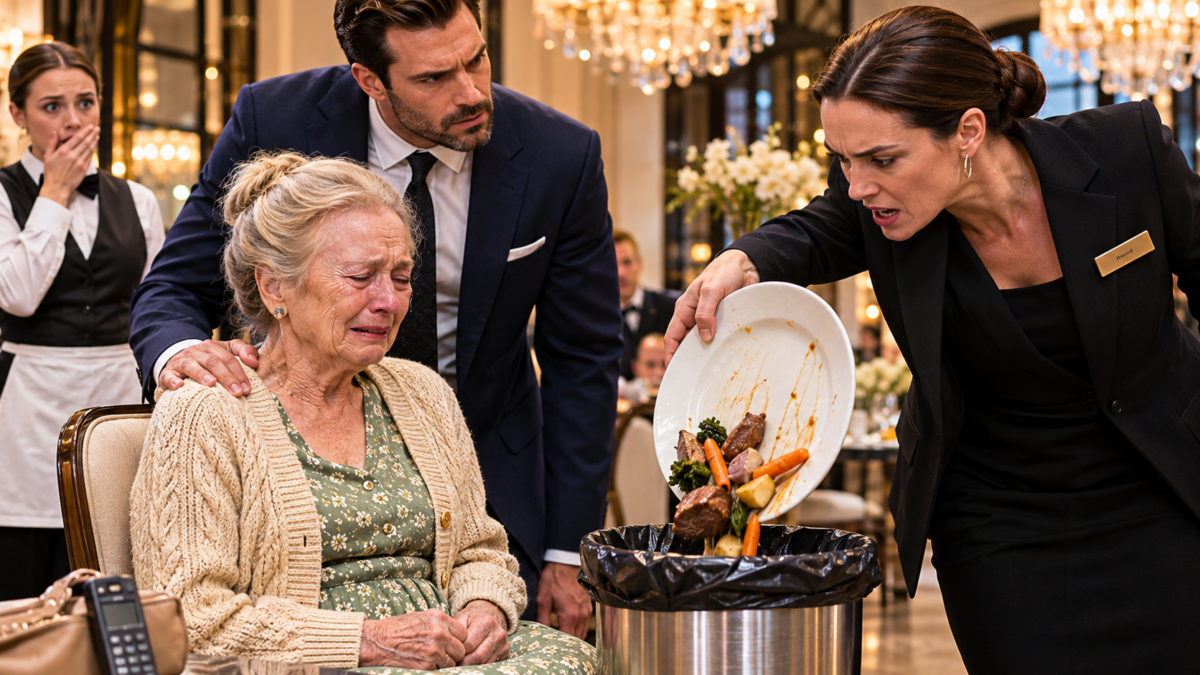
Near the center of the dining room sat an elderly woman in a pale green floral dress and a cream knitted cardigan.
Her silver-gray hair was gathered neatly into a bun.
Her name was Eleanor Whitmore.
She was seventy-six years old.
And all she wanted was a quiet dinner.
On the table beside her was a small handbag and an old black mobile phone.
She had ordered a simple meal of meat and vegetables.
She had barely begun eating when a woman in a fitted black blazer approached her table.
The woman was Vanessa Cole, the restaurant’s manager.
Her expression was cold.
She looked at Eleanor’s worn cardigan, then at the plate.
“You don’t belong here.”
Before Eleanor could respond, Vanessa took the entire dinner plate.
She carried it toward a stainless-steel trash can beside the table.
Then, without hesitation, she tilted the plate.
The meat slid off first.
Then the carrots and vegetables.
Everything fell into the garbage.
Eleanor stared at the empty plate.
Her hands tightened in her lap.
She didn’t shout.
She didn’t fight back.
Her eyes simply filled with tears.
“I was only eating.”
Across the dining room, a young waitress watched in disbelief.
Nobody moved.
But standing directly behind Eleanor was a tall man in a dark navy suit.
He had seen everything.
He gently placed his hand on Eleanor’s shoulder.
His expression hardened.
“Mom, you threw away my mother’s dinner?”
His first word was directed toward Eleanor; his shocked question was aimed at Vanessa.
The manager turned toward him.
For the first time that evening, the confidence disappeared from her face.
But what happened next was something nobody in the restaurant expected.
The Woman Everyone Had Forgotten
Eleanor Whitmore hadn’t always been a lonely elderly woman sitting quietly in expensive restaurants.
Forty-three years earlier, she and her late husband, Thomas, had opened a tiny neighborhood café.
It had only six tables.
The chairs didn’t match.
The kitchen was barely large enough for two people.
And on rainy days, water sometimes leaked through the roof.
But Eleanor loved that little café.
Every morning, she baked bread before sunrise.
Thomas made coffee.
And together, they welcomed everyone who walked through the door.
Some customers were wealthy.
Others were struggling.
Eleanor never cared.
She believed that everyone deserved to be treated with dignity.
Years passed.
The café became successful.
Eventually, the Whitmore family expanded the business.
The original café grew into a group of restaurants.
The newest location was elegant, expensive, and filled with crystal chandeliers.
But Eleanor rarely visited.
After Thomas died, she stepped away from the daily business.
Her son, Daniel Whitmore, took over most of the responsibilities.
He promised his mother that their family would never forget how the business began.
Eleanor trusted him.
And Daniel kept that promise.
At least, he tried.
The New Manager
Vanessa Cole had been hired eight months earlier.
She had an impressive résumé.
She knew how to organize expensive private dinners and attract wealthy customers.
But she believed the restaurant’s reputation depended entirely on appearances.
Over time, she became increasingly concerned about guests who didn’t look wealthy enough.
She quietly discouraged elderly customers who stayed too long.
She complained about guests wearing inexpensive clothes.
And she pressured employees to give preferential treatment to people carrying designer handbags and expensive watches.
The young waitress, Sophie, had noticed.
But Sophie needed her job.
She supported her younger brother while attending nursing school.
When Vanessa made an unfair decision, Sophie usually remained silent.
Until the night she watched her manager throw away an elderly woman’s dinner.
Why Eleanor Came Alone
That evening had a special meaning for Eleanor.
It was the anniversary of her wedding to Thomas.
Every year, she visited a place that reminded her of their life together.
Sometimes she went to their old neighborhood café.
Sometimes she sat quietly in the park where he had proposed.
This year, she wanted to visit the family’s newest restaurant.
She wore her favorite green floral dress.
Thomas had bought it for her years earlier.
The cardigan was old, but it kept her warm.
Eleanor didn’t arrive in a luxury car.
She didn’t wear expensive jewelry.
And she didn’t announce her name to the staff.
She simply wanted to order dinner.
She had chosen meat and vegetables because Thomas used to cook a similar meal for her on their anniversary.
When Vanessa threw the plate away, Eleanor wasn’t only upset about losing her food.
She remembered Thomas.
She remembered the years they had spent feeding strangers in their little café.
And she wondered how a restaurant bearing their family’s legacy had become a place where an elderly woman could be humiliated.
The Man Behind Her Chair
Daniel Whitmore had arrived at the restaurant shortly after his mother.
He was thirty-eight years old, tall, neatly dressed, and accustomed to managing serious business decisions.
That evening, he had been reviewing operational problems at the restaurant.
Several employees had complained about the manager’s behavior.
Customer feedback had also become increasingly troubling.
Daniel wanted to understand what was happening before confronting anyone.
Then he noticed his mother sitting alone.
He was about to greet her when Vanessa approached.
He heard the manager’s cold words.
He watched her take the plate.
And he saw the meal fall into the trash.
For a moment, Daniel could barely believe what he had witnessed.
His mother had helped build the company from nothing.
Yet she was sitting there crying because an employee had decided she wasn’t worthy of eating dinner.
Daniel stepped closer.
He placed his hand on Eleanor’s shoulder.
Then he confronted the manager.
Vanessa stared at him.
“Sir, I was simply maintaining the restaurant’s standards.”
Daniel looked toward the trash can.
“By throwing away a customer’s dinner?”
Vanessa tried to maintain her composure.
“She was making the dining room look inappropriate for our guests.”
Daniel’s face tightened.
“Inappropriate?”
Vanessa gestured toward Eleanor’s cardigan.
“This establishment serves a certain type of clientele.”
Daniel looked at his mother.
Then back at the manager.
“And what type of person deserves to eat here?”
Vanessa hesitated.
She had no answer.
The Name on the Ownership Papers
Daniel took a breath.
“Do you know who this woman is?”
Vanessa glanced at Eleanor.
“No, sir.”
Daniel lowered his voice.
“Her name is Eleanor Whitmore.”
Vanessa stared blankly.
Then Daniel continued.
“Whitmore Hospitality Group. Have you heard of it?”
Vanessa’s expression changed.
Of course she had.
Whitmore Hospitality Group was the company that owned the restaurant.
Daniel reached into his briefcase and took out a folder of documents he had brought for his scheduled operational review.
He opened the company’s ownership records.
Eleanor Whitmore’s name appeared among the controlling family shareholders.
Vanessa stared at the document.
Her face went pale.
Daniel spoke quietly.
“You just threw away dinner belonging to one of the people who built this business.”
The dining room fell silent.
Sophie, the young waitress, covered her mouth.
Vanessa looked from the papers to Eleanor.
Then back to Daniel.
“I… I didn’t know.”
Daniel shook his head.
“That’s the problem.”
Vanessa swallowed.
“If I’d known she was the owner—”
Daniel interrupted.
“Would you have treated her differently?”
Vanessa said nothing.
Daniel continued.
“My mother shouldn’t have to own a restaurant to deserve respect inside it.”
Those words seemed to settle over the entire room.
Eleanor looked up at her son.
Her eyes filled with fresh tears.
But this time, she wasn’t crying from humiliation.
The Truth the Employees Had Hidden
Daniel turned toward Sophie.
“Have you seen anything like this happen before?”
Sophie looked nervously at Vanessa.
For several seconds, she hesitated.
Then she nodded.
“Yes, sir.”
Vanessa’s expression hardened.
“Sophie, be careful what you say.”
Daniel raised his hand.
“She can speak freely.”
Sophie took a breath.
She explained that the manager had repeatedly treated customers differently based on their appearance.
She described several incidents involving older guests and families who appeared to have limited money.
She also revealed that employees had been afraid to report what happened.
Daniel listened without interrupting.
He asked the restaurant’s regional director to preserve customer complaints and relevant staff reports.
The director agreed to conduct a formal review.
Vanessa tried to defend herself.
She claimed she was protecting the restaurant’s image.
But Daniel had already seen enough to know that serious changes were necessary.
He immediately removed Vanessa from customer-facing duties pending an employment investigation.
The company later ended her employment after reviewing the evidence and following its procedures.
What Eleanor Asked for
After Vanessa left the dining room, Daniel turned toward his mother.
“Mom, I’m so sorry.”
Eleanor shook her head.
“You didn’t throw away my dinner.”
“But I should have known how people were being treated here.”
She gently squeezed his hand.
“Then make sure it doesn’t happen again.”
Daniel nodded.
“I will.”
He offered to have the kitchen prepare anything she wanted.
But Eleanor surprised him.
“Actually, sweetheart, there’s something else I’d like.”
“Anything.”
She looked toward Sophie.
“Could that young lady bring me another plate?”
Sophie stepped forward.
“Of course, ma’am.”
Eleanor smiled.
“And would you join us for a moment when you have time?”
Sophie looked startled.
“Me?”
“Yes, dear.”
Eleanor glanced around the elegant restaurant.
“When my husband and I opened our first café, we ate with the people who worked beside us.”
Her eyes softened.
“They were our family too.”
A Different Kind of Restaurant
Over the following weeks, Daniel made significant changes.
The company introduced clearer protections for customers and employees.
Staff received training on respectful service.
Employees were given confidential ways to report misconduct.
And managers were evaluated not only on financial performance, but also on how they treated guests and colleagues.
Daniel also restored an old tradition from Eleanor and Thomas’s first café.
Every month, the restaurant hosted a community dinner in partnership with local organizations.
People from different backgrounds shared a meal together.
No one needed expensive clothes.
No one needed an impressive job title.
Everyone received the same courtesy.
Sophie eventually became a senior member of the service team.
Her willingness to speak up had helped expose a problem that others were afraid to discuss.
And Eleanor began visiting the restaurant more often.
Not to inspect it.
But because she finally felt welcome again.
One Last Dinner
Several months later, Eleanor returned to the same table.
She wore the same green floral dress and cream cardigan.
Daniel sat beside her.
A young server approached with two plates of freshly prepared food.
Eleanor smiled as the dishes were placed before them.
She looked at the meat and vegetables.
Then she laughed softly.
“Your father would have loved this.”
Daniel smiled.
“He would have loved seeing you here.”
Eleanor looked around the dining room.
Families were talking.
An older couple laughed over dessert.
A young father helped his daughter cut her food.
And the staff moved between the tables with warmth and patience.
Eleanor’s eyes filled with tears again.
Daniel noticed.
“Mom? What’s wrong?”
She shook her head.
“Nothing, sweetheart.”
She looked toward the kitchen.
Then at the beautiful dining room that had grown from a tiny café.
“Your father and I never dreamed we’d own a place like this.”
Daniel reached for her hand.
“You built it.”
Eleanor smiled.
“No. We built a place where people could feel welcome.”
She paused.
“The building was never the most important part.”
Daniel nodded.
He finally understood.
The restaurant’s real value wasn’t its chandeliers, its marble floors, or its expensive menu.
It was how people felt when they walked through the door.
And the woman who had been told she didn’t belong there was the very person who had helped create that place.
Never judge someone’s worth by their clothes, their age, or their appearance. Respect should never depend on knowing who owns the building.
This is a fictional dramatic story. The opening confrontation is based on the supplied video; the ownership revelation and later events are an imagined continuation for entertainment.