**“MAY I HAVE THIS DANCE?”**

The magnificent ballroom fell silent.

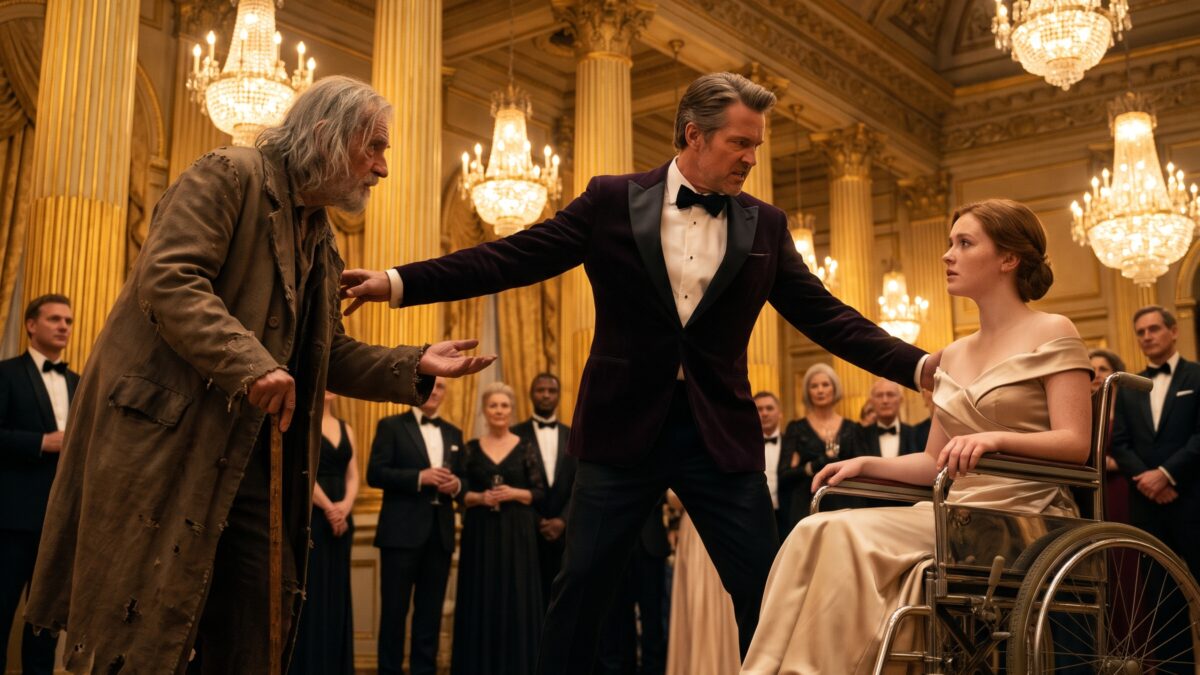
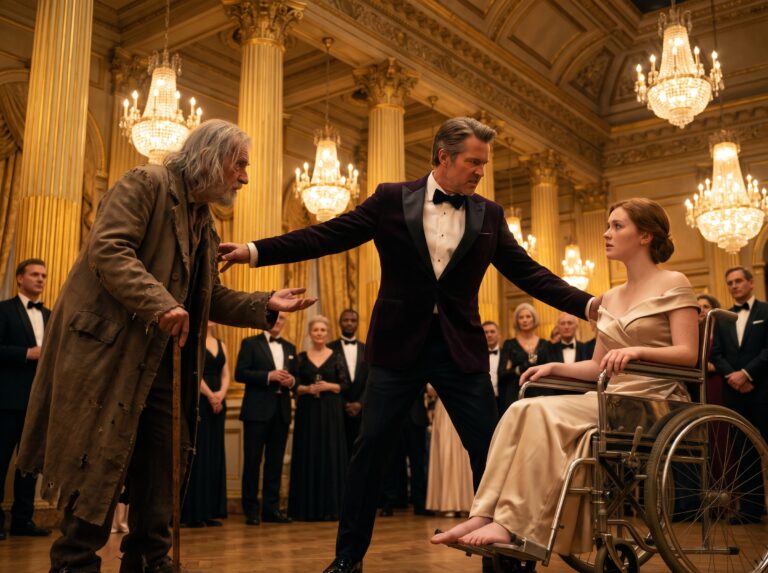
An elderly man wearing a faded brown coat stood before a beautiful young woman in a wheelchair.

His silver hair reached his shoulders.

His beard was unkempt, his shoes were worn, and his hands trembled slightly as he extended one toward her.

The young woman, Claire Whitmore, was twenty-two years old.

She wore a champagne-colored satin gown, and her copper-red hair was arranged in an elegant low bun.

She stared at the stranger in astonishment.

Before she could answer, her father stepped forward.

Richard Whitmore was a fifty-six-year-old billionaire known for his powerful personality.

Dressed in a dark plum tuxedo, he looked at the old man's shabby clothing with disgust.

**“STAY AWAY FROM MY DAUGHTER!”**

The stranger lowered his hand.

But Claire turned toward her father.

**“DAD, LET HIM SPEAK.”**

Richard hesitated.

The elderly man slowly knelt beside her wheelchair.

His expression was gentle.

“May I touch your foot?”

Claire looked down.

Then she nodded.

“Yes.”

The man carefully brushed his fingers against the top of her foot.

For one second, nothing happened.

Then Claire gasped.

Her eyes widened.

Richard leaned closer.

“What's happening?”

Claire stared at her foot.

Tears filled her eyes.

“Dad…”

Her voice broke.

**“I CAN FEEL MY FOOT!”**

Richard froze.

For six years, his daughter had lived with severely limited sensation in her legs.

Specialists had repeatedly warned that significant recovery was uncertain.

Yet now she was crying because she had felt a gentle touch.

The old man said nothing.

He simply looked at her with tears in his eyes.

But when Richard finally demanded to know who he was, the stranger revealed something that made the billionaire's face turn pale.

**He had tried to contact the Whitmore family five years earlier.**

And someone had made sure his message never reached Claire.

---

### THE GIRL WHO LOVED TO DANCE

Before the accident, Claire Whitmore had been an extraordinary dancer.

She started ballet at five.

By eleven, she was performing in national competitions.

At sixteen, she dreamed of attending a prestigious performing arts academy.

Her mother, Evelyn, supported that dream completely.

Richard was proud of his daughter, but he was frequently away on business.

Evelyn was the one who drove Claire to rehearsals, helped with costumes, and celebrated every performance.

Then tragedy struck.

One rainy evening, the car carrying Claire and Evelyn was involved in a serious collision.

Evelyn died from her injuries.

Claire survived.

But her spinal cord was injured.

After surgery and months of rehabilitation, she could no longer walk independently.

Doctors explained that she had an incomplete spinal cord injury.

Some nerve pathways might still function, but predicting long-term recovery was difficult.

For Claire, the greatest pain wasn't simply losing the ability to walk.

It was losing her mother and the future they had imagined together.

She stopped dancing.

She refused to watch recordings of her old performances.

And eventually, she stopped talking about her dreams.

Richard threw himself into providing everything money could buy.

He purchased the finest wheelchair.

He renovated their mansion.

He hired specialists.

But he couldn't bring Evelyn back.

And he couldn't make his daughter's grief disappear.

---

### THE FATHER WHO CONFUSED PROTECTION WITH CONTROL

Richard loved Claire more than anything.

But after the accident, his fear became overwhelming.

He worried constantly about her health.

He insisted on approving her appointments.

He questioned every new activity.

And whenever she expressed an interest in something physically demanding, he reminded her of the risks.

Claire gradually felt trapped.

She wanted to return to college.

She wanted to make friends.

She even wanted to explore wheelchair dancing.

But Richard worried that trying something new might lead to another disappointment.

After several years of limited progress, he reduced her rehabilitation schedule to maintenance exercises.

The decision was made with medical advice, but Claire felt that her own wishes had been overlooked.

She began to believe that everyone had already decided what her future should look like.

Then, a few months before her twenty-second birthday, she secretly contacted a community arts organization.

She asked whether people who used wheelchairs could participate in dance classes.

The answer surprised her.

Of course they could.

The organization invited her to attend a workshop.

But Claire never went.

She was afraid of telling her father.

---

### THE MAN NOBODY RECOGNIZED

The elderly stranger was named Samuel Bennett.

He was sixty-eight years old.

Years earlier, he had been a respected dance instructor and rehabilitation activity volunteer.

He believed movement could take many forms.

He had taught children.

Older adults.

And people living with disabilities.

To Samuel, dancing wasn't defined by standing on two feet.

It was about expression, music, connection, and freedom.

He had known Evelyn Whitmore long before she married Richard.

As a teenager, Evelyn had attended his community dance classes.

Even after becoming wealthy, she sometimes returned to volunteer.

She helped Samuel raise money for children whose families couldn't afford lessons.

After Claire was born, Evelyn occasionally brought her daughter to visit.

Samuel remembered a little red-haired girl dancing around the studio in oversized ballet slippers.

But life changed.

His dance studio struggled financially.

A fire destroyed much of the building.

He spent years caring for his seriously ill wife.

After her death, he was left with debts he couldn't repay.

Eventually, he lost the studio and moved into a modest rented room.

His clothing became worn.

His hair grew long.

And many people who once admired him no longer recognized him.

But he never forgot the Whitmore family.

Especially Claire.

---

### THE LETTER THAT NEVER ARRIVED

Five years earlier, Samuel had learned about Claire's accident.

He was devastated by Evelyn's death.

He wrote to Richard, offering condolences and asking whether Claire might someday be interested in an adapted dance program.

He explained that wheelchair dance could provide a creative outlet regardless of whether she ever regained the ability to walk.

He wasn't promising a cure.

He simply wanted Claire to know that her love of dancing didn't have to end.

Samuel sent the letter to Richard's office.

Weeks passed.

Nobody answered.

He tried again.

This time, he received a short response from a household administrator.

The message stated that Claire was not interested and that further contact would be inappropriate.

Samuel was disappointed.

But he respected what he believed was the family's decision.

What he didn't know was that Claire had never seen his letter.

The administrator had decided not to forward it, assuming Richard would reject the suggestion.

And Richard had never even known it existed.

For five years, Claire continued believing that dancing belonged entirely to her past.

Until the night of the Whitmore Foundation Gala.

---

### THE INVITATION THAT CHANGED EVERYTHING

Richard had organized an extravagant charity event in the family's mansion.

The foundation supported medical research and rehabilitation services.

Hundreds of wealthy guests gathered beneath crystal chandeliers.

Claire attended in a stunning champagne gown.

But she felt uncomfortable.

People repeatedly described her as brave and inspiring merely for attending the event.

Some spoke to her father rather than addressing her directly.

Others asked whether she still hoped to walk again.

Claire smiled politely.

Inside, she felt exhausted.

She wanted people to see her as a young woman with dreams, not simply as someone waiting to be cured.

Samuel had received an invitation through a local community organization.

The foundation was recognizing several programs serving people with disabilities.

He had come hoping to reconnect with the family.

But his worn coat attracted suspicious looks from the guests.

As he approached Claire, he recognized Evelyn's eyes in her face.

He also noticed how sadly she watched the couples dancing.

So he stepped forward.

And offered his hand.

“May I have this dance?”

He wasn't asking her to stand.

He wanted to show her that a dance could begin exactly where she was.

But Richard misunderstood.

“Stay away from my daughter!”

Samuel stepped back.

Then Claire spoke.

“Dad, let him speak.”

It was the first time in months she had challenged her father in front of other people.

---

### THE MOMENT EVERYONE MISUNDERSTOOD

Samuel knelt beside Claire's wheelchair.

He noticed that her foot had shifted slightly against the footrest.

Claire mentioned that she sometimes experienced unexplained tingling sensations.

Samuel listened carefully.

He explained that he wasn't a doctor and couldn't determine what those sensations meant.

But he asked whether she wanted to check if she could distinguish a light touch.

“May I touch your foot?”

“Yes.”

He gently touched the top of her foot.

Claire gasped.

It wasn't pain.

It wasn't a sudden ability to move.

It was a faint but unmistakable sensation.

She could feel where his fingers had touched.

“Dad…”

Richard bent closer.

“I can feel my foot!”

Tears rolled down her cheeks.

For years, she had struggled to notice any sensation in that area.

Now something had changed.

Richard looked from Claire to Samuel.

He demanded to know what the old man had done.

Samuel answered calmly.

He hadn't healed her.

He had simply asked permission to check something she had already been noticing.

The sensation needed proper medical evaluation.

But for Claire, the moment meant something profound.

She had expressed a concern, been listened to, and discovered something about her own body.

And nobody had dismissed her.

---

### THE TRUTH RICHARD NEVER EXPECTED

Samuel introduced himself.

When Richard heard his name, he suddenly remembered Evelyn mentioning a dance teacher from her childhood.

Samuel explained that he had known Claire when she was little.

He told Richard about the letters he had sent after the accident.

Richard looked confused.

He had never received them.

Samuel showed him the copy he had kept.

Richard read the letter slowly.

It spoke about adapted dance classes.

About helping Claire rediscover joy.

And about respecting her independence.

It contained no promises of a medical miracle.

Only an offer of friendship and support.

Richard's eyes filled with tears.

He realized that a chance for Claire to return to something she loved had been lost because people had made decisions without asking her.

For years, he had believed protecting his daughter meant keeping her away from disappointment.

But in doing so, he had stopped listening to her.

He turned toward Claire.

For the first time, he asked what she wanted.

Claire wiped away her tears.

She said she wanted to dance.

Not someday.

Not only if she could walk again.

**She wanted to dance now, exactly as she was.**

---

### THE MEDICAL EXAMINATION

The following morning, Richard arranged an appointment with Claire's rehabilitation specialist.

The medical team examined her sensation and movement.

They confirmed that she was experiencing some preserved or returning sensation in certain areas of her foot.

They explained that incomplete spinal cord injuries could produce complicated and changing patterns of sensation.

The discovery didn't mean Claire had been cured.

And it didn't guarantee that she would walk.

But it was worth documenting and considering as part of her future rehabilitation plan.

Claire participated actively in the discussion.

She asked questions.

She discussed her goals.

And she requested a therapy plan that included activities she actually enjoyed.

For the first time, Richard allowed her to lead the conversation.

The doctor encouraged her to continue exploring accessible physical activities with qualified professionals.

And Claire made her decision.

She would try wheelchair dancing.

---

### SIX MONTHS LATER

Music filled a bright community dance studio.

Claire sat in her wheelchair, wearing a beautiful blue dress.

Around her were other dancers, some standing and others using wheelchairs.

They practiced coordinated turns, arm movements, and partner routines.

Claire laughed as she followed the rhythm.

She wasn't pretending that her injury had disappeared.

She wasn't waiting for a miracle.

She was dancing.

Samuel stood nearby, watching proudly.

Richard sat in the audience.

He had attended every rehearsal that Claire invited him to.

He no longer treated her ambitions as problems to solve.

He listened.

He supported her decisions.

And he learned that his daughter's happiness wasn't dependent on whether she could stand.

As the music ended, Claire extended her hand toward Samuel.

The old man smiled.

He accepted it.

Together, they performed a gentle wheelchair dance.

Richard stood and applauded.

Tears streamed down his face.

He remembered the night he had shouted at the elderly stranger in the ballroom.

He remembered the worn brown coat.

The faded shoes.

And the extraordinary sentence his daughter had cried.

**“I CAN FEEL MY FOOT!”**

At the time, Richard believed the most important part of the evening was the unexpected sensation.

Now he understood that something even greater had happened.

Claire had found the courage to speak for herself.

And he had finally learned to listen.

---

### ONE YEAR LATER

Claire helped organize a charity performance supporting accessible dance programs.

The event took place in the same magnificent ballroom where Samuel had first approached her.

This time, the decorations were simpler.

The guests included dancers, families, therapists, and community volunteers.

Samuel arrived wearing his familiar brown coat.

Richard greeted him at the entrance.

A year earlier, he would have judged the man by his appearance.

Now he welcomed him as an honored guest.

Claire rolled toward the center of the dance floor.

She wore a champagne-colored gown.

The same color as the dress from that unforgettable night.

Samuel approached her.

He extended one hand.

And repeated the question that had changed everything.

**“May I have this dance?”**

Claire smiled.

This time, her father didn't interrupt.

He simply watched as his daughter began moving gracefully with the music.

Claire still used her wheelchair.

She continued rehabilitation and medical follow-up.

Her future remained uncertain in some ways.

But her happiness was no longer on hold.

**A poor old man had walked into a billionaire's ballroom and asked his daughter to dance.**

**The father thought he was witnessing an insult.**

**Instead, he witnessed the moment his daughter began reclaiming her confidence and independence.**

The old man hadn't performed a miracle.

He had done something much simpler.

He had treated Claire as a person with choices, dreams, and a voice that deserved to be heard.

**Because sometimes the greatest gift isn't changing someone's body.**

**It's helping them realize that their life, their dreams, and their joy still belong to them.