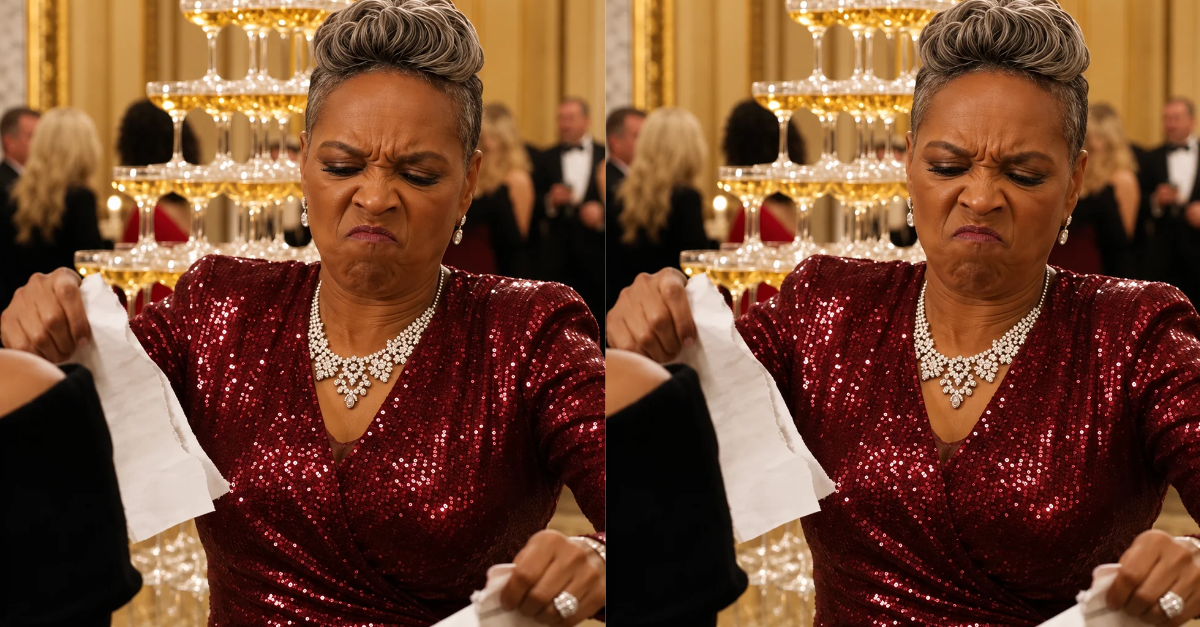
“You don’t belong here. People like you should know their place.”
The words echoed across the elegant ballroom, cutting through the soft music and cheerful conversations.
Standing near a towering champagne fountain was Diana Osa, a beautiful woman wearing a simple but elegant black evening gown. Her hair fell neatly over her shoulders, and her expression remained calm despite the humiliation unfolding in front of dozens of wealthy guests.
Facing her was Margaret Whitmore, a powerful socialite dressed in a glittering burgundy gown adorned with expensive diamonds.
Margaret looked Diana up and down with open disgust.
“Are you deaf? I said you don’t belong here.”
Diana raised an eyebrow.
“And why exactly is that?”
Margaret laughed.
“Look around, sweetheart. This is an exclusive charity gala. These people are CEOs, investors, and members of some of the wealthiest families in the country.”
She gestured toward Diana’s understated dress.
“And you clearly aren’t one of them.”
Several nearby guests turned to watch.
Diana said nothing.
Margaret pointed toward a passing waiter carrying champagne.
“If you’re looking for work, the catering staff is over there.”
Then she delivered the insult that would destroy everything.
“Go serve. People like you should know their place.”
Diana stared at her for a moment.
Then, almost unbelievably, she smiled.
“Are you absolutely sure you want to speak to me that way?”
Margaret rolled her eyes.
“Don’t embarrass yourself any further.”
What Margaret didn’t know was that the woman she had just humiliated controlled the financial future of her entire family.
And before the evening ended, she would learn that lesson in the most devastating way possible.
Earlier that afternoon, Diana had arrived at the prestigious Grand Windsor Hotel for one of the city’s most important investment galas.
She was the founder and majority owner of Meridian Capital, a private investment firm managing billions of dollars in assets.
Over the previous fifteen years, Diana had built her business from a small investment advisory company into a major international financial institution.
She had negotiated complex acquisitions, rescued struggling companies, and financed projects worth hundreds of millions of dollars.
But Diana had never enjoyed being the center of attention.
Unlike many executives, she rarely appeared in magazines or attended public celebrations.
Her colleagues knew her as a brilliant negotiator who preferred results over publicity.
That evening, she had come to the gala for a specific reason.
Meridian Capital was finalizing a $900 million acquisition and financing agreement with Whitmore International, a family-owned conglomerate involved in luxury hotels, real estate, and commercial development.
The transaction had taken nearly eight months to negotiate.
For Whitmore International, the agreement was critical.
Its cash reserves had been shrinking, and several major loans were approaching their repayment deadlines.
Without Meridian’s investment, the company faced serious financial uncertainty.
Diana had planned to meet Richard Whitmore, the company’s CEO, to discuss the final terms.
But before their meeting, she wanted to observe the event quietly.
So she arrived without an entourage, wearing a simple black dress and carrying a small handbag.
She wanted to enjoy the evening like an ordinary guest.
Unfortunately, Margaret Whitmore had other plans.
Margaret was Richard’s mother and the self-appointed queen of the family’s social circle.
For decades, she had used her wealth and family connections to command attention wherever she went.
She believed that expensive clothing, famous surnames, and prestigious invitations determined a person’s worth.
When she noticed Diana standing alone near the champagne fountain, she immediately decided the young woman didn’t belong.
“Excuse me,” Margaret said sharply. “Who invited you?”
Diana turned politely.
“Good evening. I’m here for the event.”
“That wasn’t my question.”
Diana remained calm.
“I have an invitation.”
Margaret laughed.
“Really? And who would invite someone like you?”
Diana studied her expression.
“Someone like me?”
Margaret leaned closer.
“Don’t play games. I’ve attended these events for thirty years. I know everyone who matters.”
Diana smiled faintly.
“Then perhaps there’s someone important you haven’t met yet.”
Margaret’s face hardened.
“How dare you?”
Several guests nearby exchanged uncomfortable glances.
But Margaret continued.
“This event is for successful people, not opportunists hoping to rub shoulders with the wealthy.”
Diana took a slow breath.
“Ma’am, I haven’t done anything to offend you.”
Margaret pointed toward the service entrance.
“Then make yourself useful. Go serve drinks.”
Diana’s expression changed.
Not to anger.
To disappointment.
She had spent years advising companies about leadership, ethics, and professional responsibility.
And now she was witnessing the kind of arrogance that could destroy a business from within.
“One final question,” Diana said quietly.
Margaret crossed her arms.
“What?”
“Are you associated with Whitmore International?”
Margaret laughed proudly.
“My family owns it.”
“Then you’re related to Richard Whitmore?”
“He’s my son.”
Diana nodded slowly.
“I see.”
Margaret smiled triumphantly.
“Good. Now you understand who you’re speaking to.”
Diana reached into her handbag.
“Yes,” she replied. “I understand perfectly.”
She took out her phone and dialed a number.
Margaret shook her head.
“Who are you calling? Security?”
Diana ignored the question.
When the call connected, her voice became professional and firm.
“Good evening, Daniel. It’s Diana.”
There was a short pause.
“Yes, I’m at the gala.”
She looked directly at Margaret.
Then she said the words that changed everything.
“Cancel the $900 million deal immediately.”
Margaret frowned.
“What nonsense are you talking about?”
Diana continued speaking into the phone.
“Notify the investment committee that I’m withdrawing my approval. Suspend the transaction pending formal review and inform our legal team.”
A man’s voice answered through the speaker.
“Confirmed, Ms. Osa. I’ll initiate the cancellation process immediately.”
Diana ended the call.
Margaret burst into laughter.
“Nine hundred million dollars? Please! Do you expect me to believe you’re some kind of billionaire?”
Diana slipped her phone back into her handbag.
“No, ma’am. I don’t expect you to believe anything.”
She turned to leave.
But at that exact moment, Richard Whitmore entered the ballroom.
He was a well-dressed businessman in his early forties, accompanied by two executives.
His phone suddenly rang.
He glanced at the screen and answered.
“Richard Whitmore speaking.”
His expression immediately changed.
“What?”
He stopped walking.
“That can’t be right.”
The executives beside him exchanged worried looks.
Richard’s voice became louder.
“What happened? Meridian cancelled?”
Several guests turned toward him.
Richard listened for another moment.
Then he whispered, “Oh, no.”
He lowered his phone slowly.
His face had gone pale.
Margaret approached him.
“Richard, darling, what’s wrong?”
He looked at her in disbelief.
“Our nine-hundred-million-dollar agreement with Meridian Capital has been withdrawn.”
Margaret froze.
“What?”
Richard shook his head.
“They’ve suspended the entire transaction.”
“But why?”
“I don’t know!”
Then he noticed Diana walking toward the exit.
His eyes widened.
He had seen her photograph in confidential investment presentations and had participated in several video meetings with her senior executives.
Although they had never met in person, he recognized her immediately.
“Diana?”
She continued walking.
Richard rushed after her.
“Diana, wait!”
Margaret watched in confusion.
Richard caught up with her near the entrance.
“Ms. Osa, please. What’s going on?”
Diana stopped.
“Good evening, Richard.”
He looked devastated.
“I just received a call from our legal department. They say Meridian is withdrawing from the acquisition.”
“That’s correct.”
“Why? We’ve spent eight months negotiating!”
Diana looked toward Margaret.
“Your mother gave me a very revealing introduction to your family’s values.”
Richard turned slowly.
“My mother?”
Margaret approached them.
“Richard, what is this woman talking about?”
He stared at her.
“Mother… what did you say to her?”
Margaret scoffed.
“Nothing important. I simply told her that this is a private event and she should go help the catering staff.”
Richard closed his eyes.
“Please tell me you’re joking.”
Margaret looked offended.
“Why would I joke?”
Richard turned toward Diana.
Then he asked the question that finally shattered his mother’s arrogance.
“Mother, do you have any idea who this woman is?”
Margaret shrugged.
“Some girl trying to pretend she belongs here.”
Richard’s voice trembled.
“She’s Diana Osa. The founder and owner of Meridian Capital.”
The ballroom fell silent.
Margaret’s expression went blank.
“What?”
Richard continued.
“Her company was about to invest nine hundred million dollars in ours.”
Margaret stared at Diana.
Then she looked at her son.
Then back at Diana.
“You’re the owner of Meridian Capital?”
Diana nodded.
“Yes.”
Margaret took a step backward.
“But… you don’t look…”
She stopped.
Diana finished the sentence for her.
“Rich?”
Margaret lowered her eyes.
Diana’s voice remained steady.
“You should have asked before you told me to serve.”
Richard looked as though he might collapse.
“Ms. Osa, please accept my apologies. My mother’s behavior was unacceptable.”
Diana nodded.
“I appreciate your apology.”
He stepped closer.
“Can we reconsider the agreement? Our shareholders are expecting this transaction to close. We’ve already made major financial commitments.”
Diana studied him carefully.
“Richard, Meridian Capital evaluates more than financial statements.”
“I understand.”
“We evaluate leadership, governance, and the values of the organizations we invest in.”
He nodded desperately.
“Of course.”
Diana continued.
“Your mother’s behavior tonight raises serious questions about the culture surrounding your family business.”
Richard looked toward Margaret.
For the first time in his life, he seemed completely ashamed of her.
“Mother, you need to apologize.”
Margaret immediately stepped forward.
“Ms. Osa, I’m terribly sorry. I didn’t realize you were such an important person.”
Diana’s expression hardened.
“That’s not an apology.”
Margaret looked confused.
“What do you mean?”
“You are apologizing because you discovered I have money.”
Margaret remained silent.
Diana continued.
“If I really had been a waitress, would you have treated me differently?”
No answer.
“If I had been a young woman attending this event on a scholarship, would I have deserved your respect?”
Margaret looked down.
Diana shook her head.
“That’s the problem. You don’t regret humiliating someone. You regret discovering that the person you humiliated had power.”
Richard lowered his head.
He knew she was right.
For years, he had ignored complaints about his mother’s behavior.
She had insulted employees, intimidated hotel staff, and embarrassed business associates.
And whenever someone objected, the family used its influence to make the problem disappear.
Now those same habits had created a crisis that money alone couldn’t solve.
“Ms. Osa,” Richard said quietly, “I understand why you’re upset. But hundreds of employees depend on this company.”
Diana paused.
Those words mattered.
She knew that innocent workers shouldn’t suffer unnecessarily for the actions of an arrogant executive’s family member.
“Richard, our investment committee will complete its review,” she replied. “Any future agreement would require substantial changes to corporate governance and proof that your organization treats employees and partners with dignity.”
Richard nodded.
“Whatever changes are necessary, we’ll make them.”
Diana looked at him firmly.
“Then demonstrate that through your actions, not your promises.”
She walked toward the exit.
Richard remained standing beside his mother.
For several seconds, neither spoke.
Finally, he turned toward her.
“Do you understand what you’ve done?”
Margaret’s eyes filled with tears.
“I didn’t know who she was.”
Richard shook his head.
“That’s exactly why this happened.”
Weeks later, Whitmore International announced major internal reforms.
Richard removed several family members from informal management positions, introduced an independent ethics committee, and established clear standards for workplace conduct.
Margaret resigned from her ceremonial leadership roles within the company’s charitable foundation.
For the first time, her family’s influence couldn’t protect her from the consequences of her behavior.
Meridian Capital eventually agreed to reconsider a smaller, more carefully structured investment after the company demonstrated meaningful governance improvements.
But the original $900 million agreement was never restored.
Diana made sure that every decision followed proper financial and legal procedures.
She wasn’t interested in revenge.
She was interested in protecting her investors and supporting businesses whose leadership could be trusted.
Months later, Diana attended another charity event.
This time, a young server accidentally spilled a glass of water near her table.
The woman looked terrified.
“I’m so sorry, ma’am! Please don’t tell my manager!”
Diana smiled warmly.
“Don’t worry. Accidents happen.”
She helped the young woman collect the fallen napkins.
The server looked surprised.
“Thank you. Most guests would have been furious.”
Diana looked at her kindly.
“No one deserves to be humiliated for doing an honest day’s work.”
As the young woman walked away, Diana remembered the night Margaret had told her to serve drinks.
And she smiled.
Because she had learned long ago that wealth was not measured by how many people obeyed you.
It was measured, in part, by what you chose to do with the power you possessed.
Margaret thought Diana didn’t belong in a room full of wealthy people. But when she discovered that Diana controlled the $900 million deal her family desperately needed, she learned that arrogance could cost far more than money.
The real lesson wasn’t that Diana turned out to be a powerful millionaire. It was that she deserved respect even if she had been an ordinary waitress.
Never judge someone’s worth by their clothes, their job, or their appearance. The person you dismiss today may hold opportunities you never imagined—but even if they don’t, their dignity is worth more than your pride.