A Manager Threw an Elderly Woman’s Dinner Into the Bin. Seconds Later, a Stranger Revealed a Secret That Changed Everything.
The magnificent chandeliers of Whitmore’s, one of London’s most elegant restaurants, sparkled above a room filled with wealthy diners. Soft piano music drifted through the air as waiters moved gracefully between tables.
It was the sort of place where a single meal could cost more than some people earned in a week.
That evening, however, one elderly woman seemed completely out of place.
Her name was Eleanor Harris.
At seventy-eight, Eleanor had silver hair gathered into a loose bun, tired blue eyes and hands marked by decades of hard work. She wore a faded burgundy dress and a simple beige shawl that had clearly seen better days.
She sat alone at a beautifully decorated table, looking nervously at the expensive surroundings.
A young waitress named Sophie Miller approached her.
“Good evening, madam. May I help you?”
Eleanor smiled gently.
“I hope so, dear. I was wondering whether I might have something warm to eat.”
Sophie noticed the woman’s trembling hands.
“Of course. Would you like some soup?”
“That would be lovely.”
Sophie smiled and hurried towards the kitchen.
But before she could return, a sharp voice echoed across the dining room.
“Excuse me! What exactly are you doing here?”
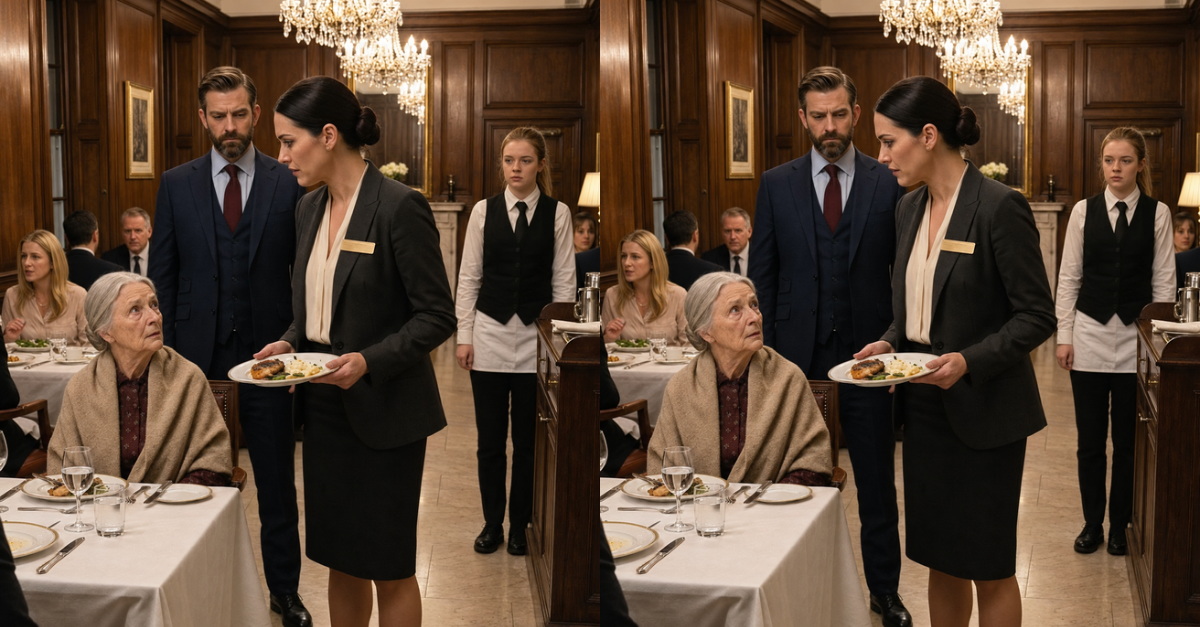
Victoria Blackwood, the restaurant manager, stood beside Eleanor’s table.
She was impeccably dressed in a tailored suit, her dark hair pulled into a perfect bun.
Eleanor looked up.
“I’m sorry. Have I done something wrong?”
Victoria examined the old woman’s clothes with visible disapproval.
“This is a private dining establishment, not a charity.”
Eleanor lowered her eyes.
“I understand. I only wanted something to eat.”
“Then perhaps you should find somewhere more suitable.”
Several diners turned towards them.
Eleanor’s cheeks flushed with embarrassment.
“I can pay something,” she whispered, reaching into her worn handbag. “I don’t have very much, but—”
Victoria interrupted her.
“You don’t belong here.”
At that moment, Sophie returned carrying a plate of food.
“Miss Blackwood, I was just bringing this lady her dinner.”
Victoria snatched the plate from Sophie’s hands.
“Then you’ve clearly misunderstood our standards.”
Before anyone could react, she walked towards a nearby rubbish bin and tipped the entire meal into it.
The sound of the food hitting the metal bin seemed to silence the entire restaurant.
Eleanor stared in disbelief.
Her lips trembled.
“I only wanted something to eat.”
A tear slipped down her cheek.
Sophie stood frozen.
“That’s cruel!” she exclaimed.
Victoria turned sharply.
“Another word, Sophie, and you can find yourself another job.”
But neither woman noticed the tall gentleman who had stopped behind Eleanor’s chair.
He wore an immaculate navy suit and had been watching everything.
His name was Edward Whitmore.
And what he had just witnessed made his blood run cold.
Edward stepped forward and gently placed a hand on Eleanor’s shoulder.
“Enough.”
Victoria spun around.
“Sir, I’m terribly sorry you had to witness this unpleasant incident. I’ll have her removed immediately.”
Edward stared at her.
“Removed?”
“Yes, sir. We have standards to maintain.”
He looked down at Eleanor.
She was quietly wiping her eyes with a tissue.
Then he turned back towards Victoria.
“Do you have any idea who she is?”
Victoria frowned.
“No. And frankly, I don’t see why it matters.”
Edward’s expression hardened.
“It matters more than you could possibly imagine.”
He pulled out the empty chair beside Eleanor and sat down.
“Mrs Harris,” he said softly, “do you remember a little boy who used to visit your café every afternoon?”
Eleanor looked at him carefully.
“I’m sorry, dear. My memory isn’t what it used to be.”
“He wore an oversized school jumper. His shoes were always falling apart. And he never had enough money for lunch.”
Something changed in Eleanor’s expression.
Edward continued.
“You used to give him a hot meal every single day. You told him there was always an extra portion in the kitchen.”
Eleanor slowly covered her mouth.
“Little Eddie?”
Edward nodded, his eyes shining.
“Yes. It’s me.”
For a moment, she could only stare.
Then she reached towards his face.
“Oh, my goodness. Look at you!”
Edward gently held her hands.
“I’ve been looking for you for years.”
Thirty years earlier, Eleanor had owned a tiny café in East London.
It was nothing like the glamorous restaurant around them.
The tables were mismatched, the walls needed painting, and the little kitchen barely had room for two people.
But everyone in the neighbourhood knew Eleanor.
She never turned away a hungry child.
Edward had been one of those children.
His mother worked long hours cleaning offices, and there were evenings when the family had little food left.
Every day after school, Edward would stop outside Eleanor’s café and stare through the window.
One rainy afternoon, Eleanor invited him inside.
“Come on, love. You look frozen.”
“I haven’t got any money,” he admitted.
“Who said anything about money?”
She placed a bowl of hot stew in front of him.
When Edward hesitated, she smiled.
“Everyone deserves a proper meal.”
That became their little routine.
For nearly four years, Eleanor fed him, encouraged him and helped him with his schoolwork whenever she had time.
When Edward won a scholarship to university, Eleanor was among the first people he told.
“I’ll repay you one day,” he promised.
She shook her head.
“Don’t repay me, Eddie. Help somebody else when you can. That’s all I ask.”
Edward never forgot those words.
He went on to build a successful hospitality business. Years later, he opened his most prestigious restaurant and named it Whitmore’s.
But when he returned to visit Eleanor, her café had disappeared.
The building had been demolished during redevelopment.
Nobody seemed to know where she had gone.
Edward searched for years.
And now, by pure chance, she was sitting in his own restaurant.
Victoria stood motionless.
“Mr Whitmore?” she whispered.
He rose slowly.
“Yes, Victoria. I am Edward Whitmore. I own this restaurant.”
The manager went pale.
“Sir, I had no idea—”
“That she knew me?” Edward interrupted.
“No, sir. I mean—”
“Would you have treated her differently if you had known?”
Victoria opened her mouth, but no words came.
Edward glanced around the dining room.
“Look at this place. The chandeliers. The expensive furniture. The reputation.”
He paused.
“Do you know where the idea for this restaurant came from?”
Nobody answered.
“From a little café where a woman served hungry children without asking whether they could afford to eat.”
He turned towards Eleanor.
“That woman is sitting right here.”
Sophie wiped a tear from her cheek.
Edward looked back at Victoria.
“I hired you to manage a restaurant. I did not hire you to decide who deserves dignity.”
“Please, sir,” Victoria whispered. “I made a mistake.”
“You did,” Edward replied. “And an apology alone won’t undo it.”
He instructed Victoria to leave the dining room while the matter was formally reviewed. After examining the incident and speaking to staff, the restaurant ended her employment.
Edward then turned to Sophie.
“Thank you for speaking up.”
Sophie looked surprised.
“I should have stopped her sooner.”
“You tried. And you were the only member of staff who challenged what happened.”
He asked her to bring Eleanor a fresh meal.
“And whatever she chooses,” he added, “please make sure it’s made with care.”
Later that evening, Eleanor sat enjoying a warm dinner while Edward listened to stories about their old neighbourhood.
He learnt that she had lost her café when the building was sold. Rising living costs had eventually forced her into a small rented room.
She had come to Whitmore’s that evening because she had seen Edward’s photograph in a newspaper article and wondered whether the successful restaurateur might be the boy she once knew.
“I didn’t want anything from you,” she explained. “I just wanted to see how you’d turned out.”
Edward looked at her, overwhelmed.
“You should never have had to wonder whether you were welcome here.”
Eleanor smiled.
“I’m just glad you’re doing well, Eddie.”
He shook his head gently.
“Everything good I’ve built began with people like you.”
A month later, Whitmore’s introduced a community dining programme, providing free meals every weekday for people experiencing hardship.
Sophie became the programme’s coordinator.
And Eleanor, at Edward’s invitation, visited regularly to share recipes and welcome guests.
Edward also helped her secure a comfortable, permanent home, with support arranged according to her wishes.
But his most meaningful gesture was much smaller.
At the entrance to Whitmore’s, he installed a simple brass plaque.
It read:
“INSPIRED BY ELEANOR HARRIS, WHO TAUGHT ME THAT NO ONE SHOULD EVER HAVE TO EARN THE RIGHT TO BE TREATED WITH KINDNESS.”
On the day the plaque was unveiled, Eleanor stood beside Edward as the restaurant’s staff gathered around them.
“You didn’t need to do all this,” she whispered.
Edward smiled.
“Do you remember what you told me when I promised to repay you?”
She nodded slowly.
“Help somebody else when you can.”
He gestured towards the dining room, where families and elderly guests were enjoying hot meals together.
“That’s what we’re doing.”
Eleanor’s eyes filled with happy tears.
And for the first time in many years, she felt she had found a place where she truly belonged.
THE END