The winter morning was bitterly cold in the little English town of Ashbourne. Frost covered the pavements, and a grey sky hung above the quiet high street.
Inside a modest café called The Copper Kettle, twenty-six-year-old Charlotte Bennett was beginning another exhausting shift.
Charlotte had worked there for nearly three years. Her wages barely covered the rent on her tiny flat, her electricity bills, and the money she sent to her mother, who had been struggling financially since her father passed away.
Still, Charlotte never lost her kindness.
At precisely half past nine, the café door creaked open.
An elderly man stepped inside.
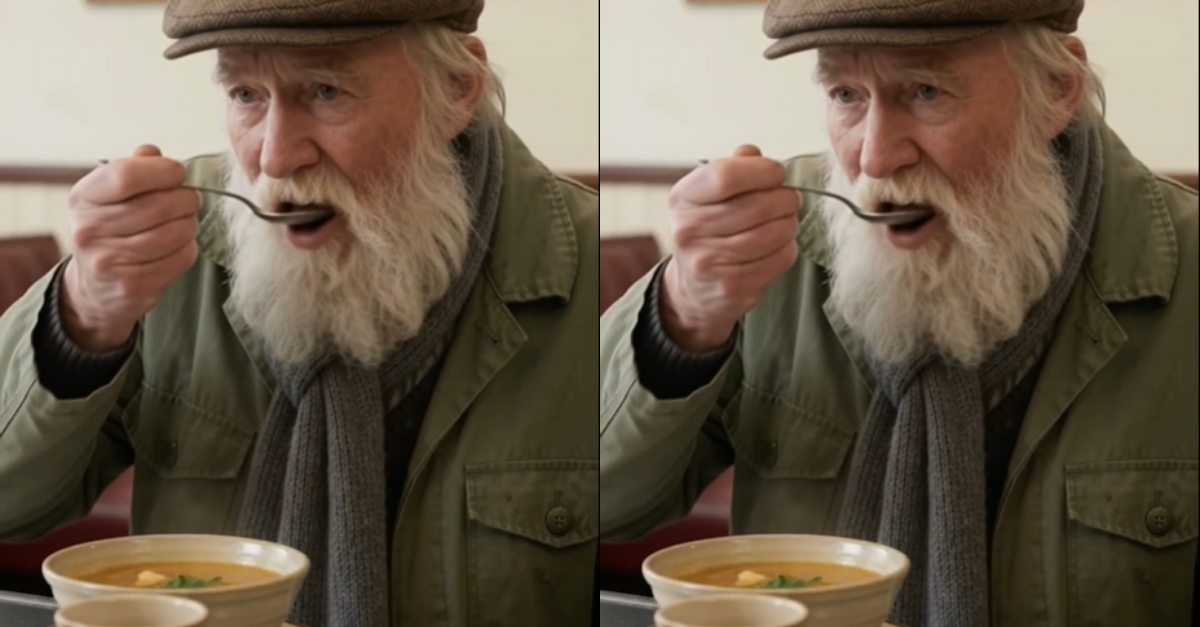
He looked about seventy-five, with a long silver beard, tired blue eyes, and an old brown flat cap. His moss-green coat was worn at the elbows, and his hands trembled slightly as he removed his gloves.
The man stood by the entrance, looking uncertain.
“Morning, love,” Charlotte said warmly. “Come in out of the cold.”
The old man gave a faint smile.
“Thank you. I was wondering if I might have a little hot water.”
“Of course. Would you like something to eat?”
He lowered his eyes.
“No, thank you. I don’t think I can afford anything today.”
Charlotte glanced at his thin, trembling hands.
She had seen plenty of struggling customers over the years, but there was something particularly heartbreaking about this man.
“How about a bowl of soup?” she suggested.
He shook his head.
“I really haven’t got the money.”
“Don’t worry about that. I’ll sort it out.”
Within minutes, Charlotte placed a steaming bowl of vegetable soup and two slices of buttered bread in front of him.
The old man stared at the food.
“Are you quite sure?”
“Absolutely. Enjoy your meal.”
His eyes glistened.
“Thank you, love. That’s very kind of you.”
Charlotte smiled and returned to her work.
She didn’t notice the expensive black car that had stopped across the street.
Nor did she see the well-dressed man watching the café through its front window.
His name was James Whitmore.
And he had been searching for the elderly man for weeks.
Arthur Williams ate slowly, savouring every spoonful.
When he finished, he wiped his mouth carefully with a paper napkin.
“That was wonderful,” he told Charlotte.
“I’m glad you enjoyed it.”
He searched inside his coat pocket and produced a single old pound coin.
It was scratched and worn, with a small mark near its edge.
“Please,” he said. “Take this.”
Charlotte shook her head.
“You don’t owe me anything.”
“But it’s all I’ve got.”
“Then you should keep it. You might need it later.”
For a moment, Arthur looked at her without speaking.
Then he gently placed the coin beside an old ceramic cup on the counter.
“Some things,” he murmured, “are worth more than what they appear to be.”
Charlotte didn’t quite understand.
Before she could ask, Arthur stood, thanked her once more, and walked into the freezing morning.
A few seconds later, the café door opened again.
This time, a tall man in an immaculate charcoal-grey suit entered.
His polished shoes clicked against the tiled floor.
Charlotte recognised him immediately.
James Whitmore was the new owner of the café.
He had recently purchased the premises, and there had been rumours that he intended to close it.
“Mr Whitmore,” Charlotte said nervously. “Good morning.”
James barely acknowledged her greeting.
His eyes were fixed on the empty bowl, the old cup, and the coin lying on the counter.
“What’s going on here?”
Charlotte hesitated.
“I was just helping him, sir.”
James picked up the coin and examined it.
His expression changed.
“Did he pay for that?”
Charlotte swallowed.
“No. I paid for it myself.”
A tense silence filled the café.
James looked at her, then towards the door through which Arthur had disappeared.
Finally, he spoke.
“Do you realise who that man was?”
Charlotte felt her stomach tighten.
“No, sir.”
James held up the coin.
“His name is Arthur Williams.”
Charlotte waited.
“And twenty-eight years ago, he saved my life.”
James pulled out a chair and sat down.
For the first time, the confident businessman looked vulnerable.
“When I was seven, my mother and I lived in a small rented house outside Birmingham,” he began.
“My father had left us. Mum worked two jobs, but we still struggled to afford food.”
Charlotte listened quietly.
“One December evening, she collapsed at work. I was left outside a shop in the cold, frightened and hungry. I had no idea how to get home.”
James glanced at the coin.
“An elderly shopkeeper found me. He brought me inside, made me a sandwich, and stayed with me until someone came to help.”
“That was Arthur?” Charlotte whispered.
James nodded.
“He didn’t ask for anything. When I tried to give him the pound coin Mum had left me, he refused.”
James turned the coin over.
“Instead, he scratched this little mark onto it and handed it back. He told me to keep it as a reminder that kindness should always be passed on.”
Charlotte stared at the scratched metal.
“Years later, I went back to thank him,” James continued. “But his shop had closed. He’d lost his business, his home, and almost everything he owned.”
For years, James tried to locate him.
Only recently had a local charity told him that Arthur was living in temporary accommodation nearby.
“That’s why I came here today,” James said.
“I was supposed to meet him. I saw him enter the café, but by the time I parked, he’d already gone.”
Charlotte looked towards the empty seat.
James’s voice trembled.
“He gave me food when I was a hungry child. And this morning, when he was hungry himself, you did exactly the same for him.”
Charlotte felt tears gathering in her eyes.
“I only bought him some soup.”
James shook his head.
“No. You treated him like a person when he had almost nothing.”
The next morning, James returned to the café with Arthur.
The elderly man looked bewildered as James guided him to a table.
Charlotte hurried over.
“Arthur! It’s lovely to see you again.”
Arthur smiled.
“Hello, love.”
James sat beside him.
“Arthur, do you remember a little boy you helped one winter evening in Birmingham?”
Arthur frowned thoughtfully.
“There were quite a few children who came through my shop.”
James placed the marked pound coin on the table.
Arthur stared at it.
His hands began to shake.
“The little boy whose mum was ill?” he whispered.
James nodded.
“That was me.”
Arthur covered his mouth.
For a long moment, neither man spoke.
Then James reached across the table and gently took Arthur’s hand.
“I’ve spent years looking for you.”
Arthur’s eyes filled with tears.
“I always wondered what happened to you.”
“Your kindness stayed with me,” James replied. “And now I’d like to return it.”
James explained that he had arranged secure accommodation for Arthur and offered to help him access the support he needed.
But that wasn’t all.
He turned to Charlotte.
“I bought this café because I wanted to turn it into something meaningful. Yesterday, you showed me exactly what it should become.”
Charlotte looked confused.
“What do you mean?”
“I’m keeping the café open. From now on, anyone who genuinely can’t afford a hot meal can have one without being turned away. I’ll cover the cost.”
Charlotte stared at him in disbelief.
“And I’d like you to manage it.”
Her eyes widened.
“Me?”
“Yes. You already understand what matters most.”
Three months later, The Copper Kettle had become more than a café.
Every afternoon, elderly residents, struggling families, and people facing difficult circumstances could find a warm meal and a welcoming conversation.
Arthur visited nearly every morning.
He always sat at the same table beside the window.
And each time, Charlotte brought him a bowl of soup.
One afternoon, Arthur noticed a small glass frame hanging behind the counter.
Inside it was the old scratched pound coin.
Beneath it were the words:
“A SMALL ACT OF KINDNESS CAN CHANGE A LIFE.”
Arthur looked at Charlotte.
“You kept it?”
She smiled.
“Of course.”
“But why?”
Charlotte glanced around the busy café.
“Because it reminds us how all of this started.”
Arthur looked at the people eating, talking, and laughing together.
Then he said quietly:
“I thought I’d lost everything that mattered.”
Charlotte sat beside him.
“You hadn’t, Arthur.”
He looked at her.
“You still had the kindness you’d given away.”
Outside, winter sunlight broke through the clouds.
And inside the little café, a simple bowl of soup had become the beginning of something extraordinary.
Because the true price of kindness isn’t what it costs to give. It’s the difference it makes to someone who needs it.
THE END